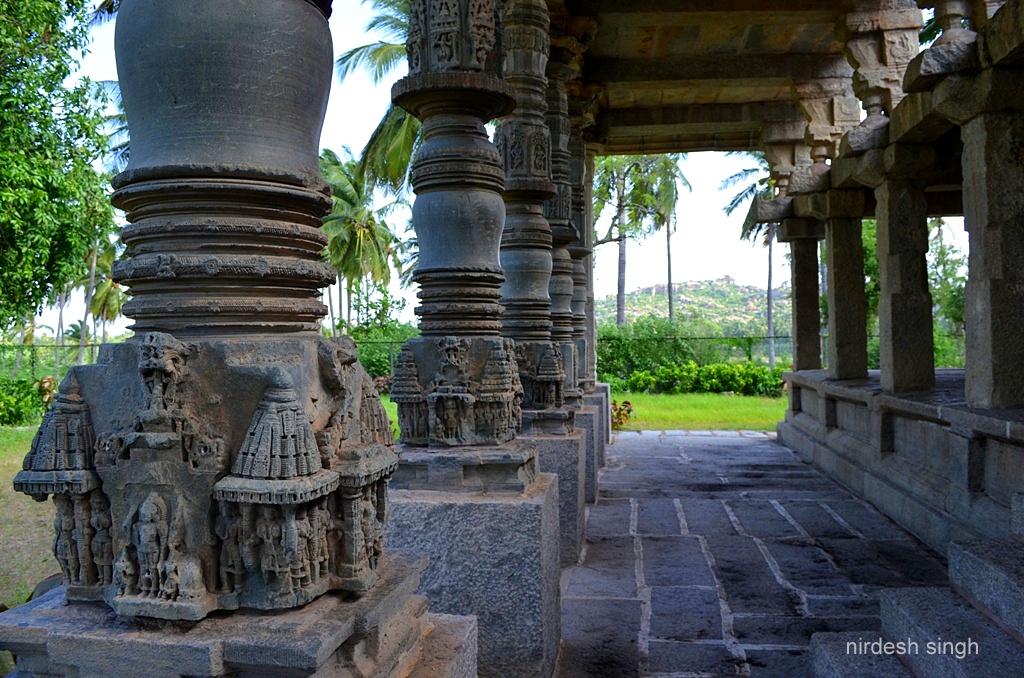
From
a distance it seems pebbles have been strewn around carelessly forming mounds.
Coming closer, the huge loose granite boulders begin to take shape. Stretched
among these precariously balanced boulders piled high, paddy fields glow in the
morning sun. Coconut palms sway to the music of the breeze. The sparkling
Tungabhadra River flows serenely. High up, a lone mantapa perched on the side of the hill standing guard for
centuries watches this scene dispassionately. This is the hauntingly enchanting
landscape of UNESCO World Heritage Site Hampi in Karnataka that witnessed the
rise and downfall of one of the greatest Hindu Kingdom of Vijayanagara.
The high fortification walls bring you to Zenana Enclosure. Inside, the Lotus Mahal and the elephant stables with pointed arches, vaults and domes built in distinct Islamic architecture are apparently inspired by the contemporary neighbouring Bahmani Kingdom. In fact, there is an entire Islamic Quarter near the Malyavanta Hill which points to cosmopolitan spirit of Vijayanagara.

You just realise that not a day goes by when you don’t miss Hampi. It seems you have known each other for ages. The next time you will come for a longer visit. You want to spend more time with her. You feel her anguish. We will both sit holding hands looking into each other’s eyes. And then we will let the tears flow. We will cry together – at our ruins, at our fate and our lost glory.
The spread is delicious enough to eat


Related Stories on this Blog
Some more Hampi Magic


 |
| The Classic Hampi Landscape - you could look at it for the rest of your life - boulders, palms, Tungabhadra and the ruins |
The
love story that started few years ago has grown stronger over several visits. It
was love at first sight with the austere and grandiose Hampi and now every
visit is a joyous homecoming. The ochre boulders, the green banana plantations
and the grey ruins seem to hold you into a lulling embrace filling your entire
being with surging bliss. You want to see, feel and experience more of Hampi.
 |
| The Bazaar area of Krishna Temple - One of the four temple complexes in Hampi and as with every temple complex there is a huge Pushkarni |
This
is Kishkindha, the Monkey Kingdom where several episodes of Ramayana were played
out. Ram & Lakshman had arrived here looking for the abducted Sita when
they met Sugriv and his chief minister Hanuman. Upon Hanuman’s request, Ram
kills the usurper brother Vali restoring the kingdom to Sugriv whose help was
needed to find Sita. Across Tungabhadra, overlooking the Pampa Sarovar where
Ram bathed, Sabari fed berries to Ram. The stories don’t end here. The Pampa
Sarovar or Lotus Pond is named after Brahma’s daughter Pampa who performed
penances on Hemakuta Hill attracting attention of Shiva. Shiva seated in
meditation after destroying Kama, god of love, finally relented and married
Pampa and she became identified as his consort Parvati. The God and Goddess are
worshipped in Virupaksha Temple; Hampi or Pampakshetra’s oldest temple.
Locally, Shiva is known as Virupaksha.
 |
| The King's Balance - the kings supposedly got themselves weighed in gold and silver and then donated it to the public - on the walking trail along the Tungabhadra from Virupaksha Temple to Vitthal Temple |
In 1336, two
brothers Harihara and Bukka, who probably ruled over the tiny principality of
Anegundi, crossed over the Tungabhadra to establish the capital city of
Vijaynagara – City of Victory - which grew into the formidable Vijaynagara
Empire. Over a period of 200 years, the kingdom would become fabulously rich,
powerful and the largest in South India. Vijaynagara became an important
trading centre. Chroniclers from Persia, Italy and Portugal who visited during
this period were dazzled by the unrivalled imperial splendour, the likes of
which they had not seen before.
 |
| Last time the serene Tungabhadra raged during the monsoons and you wimped out and refused to climb the boat. This time you jump across the boulders to discover the Bohemian piece of Hampi with shacks and budget hotels catering to backpackers |
The
magnificence of Hampi is best appreciated by walking. Virupakhsa Temple, patronized
by the founders and around which the city grew is the logical place to start. Hemakuta
Hill with its smattering of temples and mantapas
lies to the south offering atmospheric views of the temple and its towering
gopuras. The sprawling temple complex has a 100-columned hall and coronation mandap decorated with fantastic yalis and makaras. The ceiling has brilliant paintings depicting mythological
scenes and royal life. The living temple sees the most visitors and devotees
thronging the mandaps and sanctum.
Don’t miss Laxmi, the petite elephant blessing the visitors. Emerge out from
the north gateway to the Manmatha pushkarni. Just beyond the Tungabhadra flows.
 |
| Hampi's skies are always atmospheric and here they seem to be in a mixed mood - Manmantha Pushkarni at the living Virupaksha Temple |
Come back to
Hampi Bazaar where a long colonnaded bazaar stretches in front of Virupaksha
Temple, one of the four street bazaars, a feature common to all the temples in
the sacred centre. At the far end, a colossal Nandi is seated in a mandap with the
backdrop of Matanga Hill.
 |
| You can keep going to Hampi forever for this sight. Ride the circular boats made of reed and bamboo. Just like the inhabitants of Vijaynagar did hundreds of years ago. In the distance is the Anjanadri Hill in Anegundi where Hanuman was born |
If you want to
go back into time, turn left from Hampi Bazaar and walk along Tungabhadra with
perhaps the most remarkable setting. Time seems to have stopped here. Devotees
dressed like they did 700 years ago rest on the rocks at Chakratirtha, the
holiest bathing spot, after paying obeisance at the Kodandrama Temple. Circular
boats made of reed and bamboo called coracles rest on the riverbank like they
have done through the ages. Sit with the devotees as you watch the tranquil
waters flow through a gorge towards Anjanadri Hill, where Hanuman was born.
Hampi is a window where you can watch mythology, lost glory of Vijaynagar and
the present in the same frame.
 |
| The lofty gopurums of the temples in Hampi are built of bricks with stucco bas relief ornamentation. Exposure to elements have damaged the gopurams. Conservation efforts are underway at Krishna Temple |
Continue
walking along the river, as you pass the Courtesan’s Street, another bazaar
that leads to the third temple complex Achyutaraya Temple, until you reach a
double storeyed pavilion like gateway with the King’s Balance next to it where
the kings were weighed against gold and gems. This brings you to the most
ornate temple complex called Vitthal Temple. Here the iconic Garuda shrine in
the form of wheeled chariot pulled by horses stands splendidly under blue
skies.
 |
| Hampi - Every visit to Hampi reveals more surprises. Here you meet the most enchanting and the prettiest woman in whole of Vijaynagar - what flair what verve and what a hairstyle - You are in love! |
But
then all good things come to an end. The Deccan Sultanates to the North form a
coalition. Vijaynagar army is routed in the Battle of Talikota in 1565. For
next six months, the beautiful city is ravaged and pillaged. The ruined town is
soon abandoned. The lively streets and bazaars that saw merchants from across
the world trade gold, gems, ivory, brocade, silk and horses were soon overgrown
and forgotten.
 |
| You love the blue skies over Hampi. They add that extra dimension to the ruins and the landscape. Here, last time you were treated to a beautiful sunset; this time ruins and wrestling sculptures |
The
Royal Enclosure bore the brunt of the pillage that followed the doomed battle.
Nothing survives except the beautiful unearthed pushkarni with elevated stone
aqueducts and the massive three-tiered Mahanavami Dibba platform. During the
nine days of Navaratri, the king sat on a gem studded throne on top witnessing
the grand celebrations with dazzling display of wealth and power. Foreign chroniclers have left glowing accounts
of the extravagant pomp and splendour.
 |
| The Zenana Enclosure is relatively damaged and houses the prettiest structures - The Lotus Mahal incorporating distinct Islamic architecture is one of Hampi's most recognisable monument |
 |
| Hampi - The Elephant Stables |
The high fortification walls bring you to Zenana Enclosure. Inside, the Lotus Mahal and the elephant stables with pointed arches, vaults and domes built in distinct Islamic architecture are apparently inspired by the contemporary neighbouring Bahmani Kingdom. In fact, there is an entire Islamic Quarter near the Malyavanta Hill which points to cosmopolitan spirit of Vijayanagara.
 |
| The higher you climb the Matanga Hill, the more spectacular Hampi turns - Here is the bird's eye view of the massive Achyutaraya Temple |
After
a full day of exploring on foot, there is one last promise to keep. You are back
at the entrance of Achyutaraya Temple. Unfrequented by the tourists, it is all
quiet here. On the right rises the craggy Matanga Hill. The rounded boulders
have inexplicably arranged themselves to form the highest peak in Hampi. You
have promised yourself that this time you will climb to the top for the breath-taking
sunset views. A passing shower has made the steep climb on the broken steps built
during Vijayanagara times treacherous. With every step the views turn stunning.
For the first time you get bird’s eye view of the most surreal landscape in the country - the same pebble like boulders, the patches of green and to the north the sliver of Tungabhadra. The Virupaksha Temple radiates golden aura under the setting sun. The prayers from the temple wafts up along with the cool breeze. The sky changes colour every minute. You want to savour every moment. This is your Promised Land.
For the first time you get bird’s eye view of the most surreal landscape in the country - the same pebble like boulders, the patches of green and to the north the sliver of Tungabhadra. The Virupaksha Temple radiates golden aura under the setting sun. The prayers from the temple wafts up along with the cool breeze. The sky changes colour every minute. You want to savour every moment. This is your Promised Land.
 |
| The views were worth waiting for five years - On top of Matanga Hill and looking towards Virupaksha Temple |
You just realise that not a day goes by when you don’t miss Hampi. It seems you have known each other for ages. The next time you will come for a longer visit. You want to spend more time with her. You feel her anguish. We will both sit holding hands looking into each other’s eyes. And then we will let the tears flow. We will cry together – at our ruins, at our fate and our lost glory.
Must Do Things in and around Hampi
Ride
a coracle on Tungabhadra river
Watch
the sun go down over Hampi from top of Matanga Hill
Walk
along Tungabhadra river from Hampi Bazaar to Vitthal Temple
Enjoy
a slice of bohemian Hampi across the river from Virupaksha Temple
Marvel
at never seen before pre-historic art at Onake Kindi near Chikkarampur Village
Enjoy
some fish angling at the sublime Sanapur Lake
Discover
the quiet Anegundi Village where the story of Vijaynagara began
A
Version of this story appeared in the March-April issue of Inflight Magazine
Trujetter
The spread is delicious enough to eat


Related Stories on this Blog
Some more Hampi Magic