Showing posts with label Narayan Sarovar. Show all posts

Wednesday, 4 May 2016

Where once the Indus Flowed - Narayan Sarovar, Koteshwar Mahadev, The Great Indian Bustard and Mandvi

The Great Gujarat Road Odyssey – Day 7: Kutch to Saurashtra

Today, the plan is undertake a long drive that will see you leave Kutch and reach Jamnagar in the night. The drive is going to be 500 kms long and it is imperative that you fuel up on the fulfilling and wholesome staple breakfast of fafda and jalebi. 

The Gujarati breakfast of fafda and jalebi - of course, the tea has to be slurped from the plate


The fafdas are coming out hot just outside the gates of the dharamshala you stayed in for the night. 

Shree Kutch Narayan Sarovar Annakshetra ane Bhojanalay - The dharamshala to stay in Narayan Sarovar

The Shree Kutch Narayan Sarovar Annakshetra ane Bhojanalay Dharamshala in Narayan Sarovar is a quiet and clean affair to stay for the night. They charge nominally for the rooms and offer free meals. Of course, you are welcome to make donations.


The fortification walls and the spiked gate that protects the temple complex
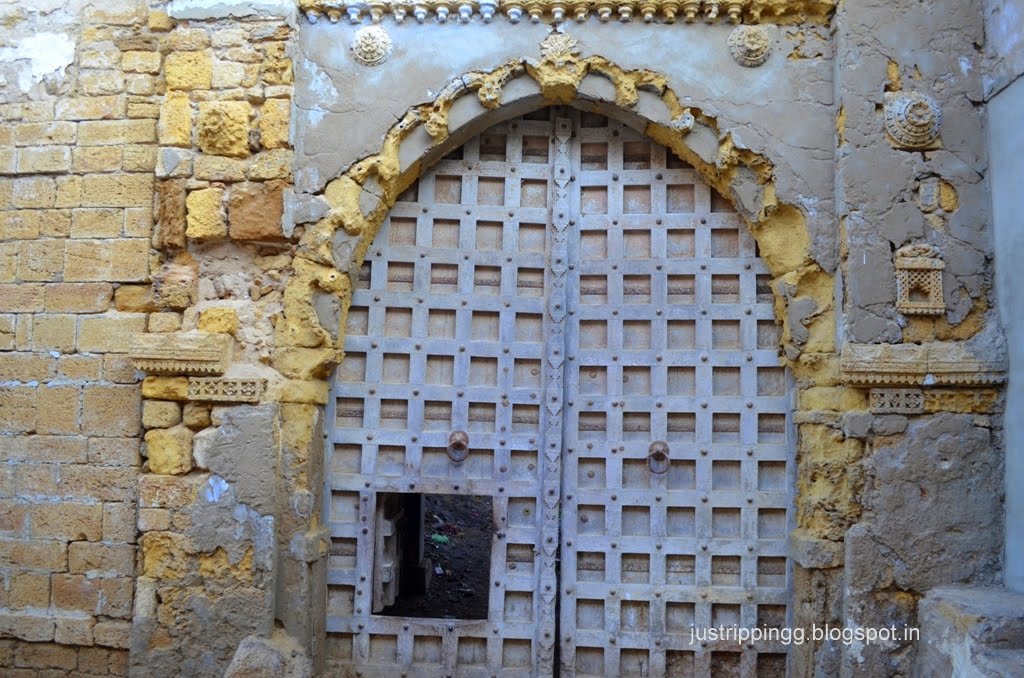
Okay, now that you notice, there are fortification walls where you are eating. You finish up the last of the jalebis. A spiked gate leads you inside the fortified complex with number of temples and residences. 
The Narayan Sarovar Temple Complex

This is the Narayan Sarovar temple complex. The main courtyard has seven temples. Maharani Vagheli Mankunvar, wife of Rao Desalji (1718-1741), had an unpleasant experience with the priest of Dwarkadhish (but then who doesn’t have unpleasant experiences with pandas) at Dwarka and decided to create another pilgrimage centre that could rival Dwarka. She first built two temples of Lakshminarayan and Trivikramray. In addition, she built five temples in a row. These five temples are dedicated to Lakshmiji, Dwarkanath or Ranchhodji, Govardhannath, Adinarayan and Lakshminarayan. The shikhars of the temples glow in the early morning sun.

The gate on the left leads to the Narayan Sarovar just outside the fort walls
On the other side of the courtyard, a door pierces the wall. Steps lead down to the waters of the holy Narayan Sarovar. Bhagwat Puran mentions a great lake called Narayan Saras visited by devotees and Siddhas. Once upon a time the Indus would feed this lake before the river’s course was changed by the earthquake of 1819. The earthquake created a dam called Allah Band to the north of Lakhpat that shifted the Indus west, turning the Rann dry. Alexander too recorded seeing the huge lake in 325 BC. (Some of the Greeks later settled in Vadnagar). Now the huge lake has disappeared leaving a small tank with steps leading to the ghats on three sides. Temples dot the ghats.

Narayansar or Narayan Sarovar - one of the five holy sarovars
Narayansar or Narayan Sarovar is one of the five holy sarovars of Hindus. The other four are Mansarovar in Tibet, Pushkar in Rajasthan, Bindu Sarovar in Sidhpur, Gujarat and Pampa Sarovar in Anegundi, Karnataka. You are pleased to realise that except Mansarovar, you have now seen them all.

It is cold in the morning discouraging any devotee to take a dip. There are not many devotees here this morning and the priests are eyeing you expectedly - the trick is to avoid eye-contact and keep walking!
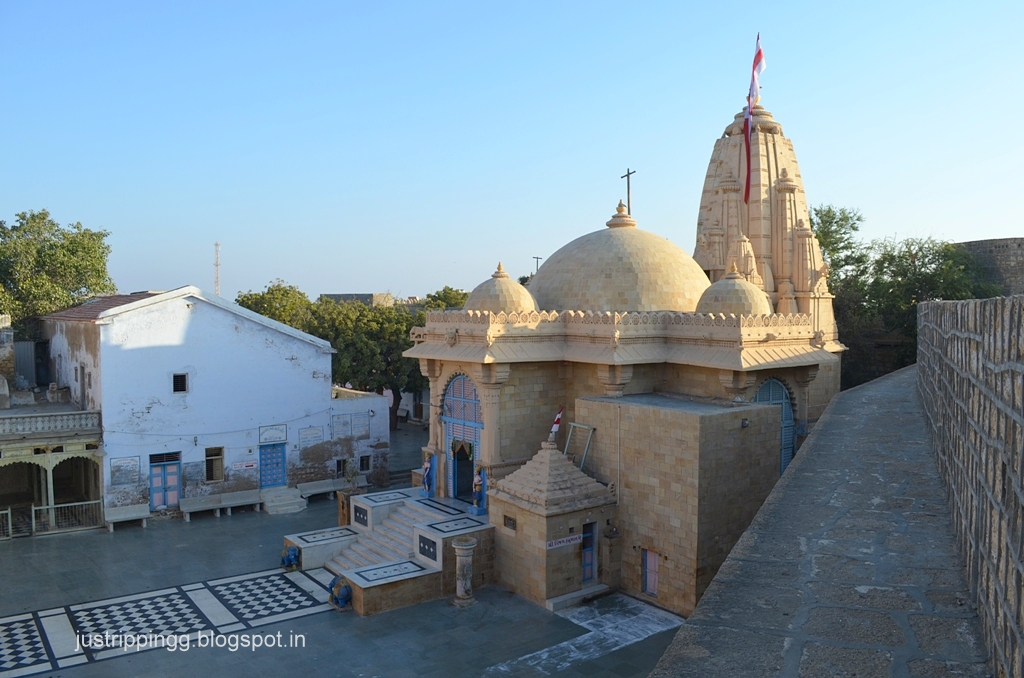
The Trivikramray Temple at Narayan Sarovar, Kutch Gujarat
View of the Narayansar or Narayan Sarovar from the fort walls
You come back into the courtyard to find the steps that will take you on top of the battlements. This time you will walk your way out taking the aerial route. Now that you realise, the Trivikramray Temple does look like Koteshwar Mahadev Temple from your vantage point on the wall.

Checking out of the dharamshala, you decide to go back to the nearby Koteshwar Mahadev Temple to have another look, this time in the daytime.
This is how Koteshwar Mahadev looks like when coming from Narayan Sarovar about a km away
Koteshwar, the Ten Million Gods, is built at the mouth of the Kori Creek. Once upon a time, the town was probably cut-off from the mainland by tidal creeks but now a causeway is built from Narayan Sarovar. Last evening, you were enchanted by the dreamy sunset over the lapping waves. The setting sun cast its golden light on the Koteshwar Mahadev Temple, the western-most Temple in India. 

Who says photography is easy - here you stand at one spot for 12 hours to catch these two moments
This is how it looked last evening - Kori Creek at Koteshwar Mahadev Temple, Kutch
Mythology has it that Ravan built this temple when the ling he was carrying shattered into crores of pieces. Hsuan Tsang had visited Koteshwar in 640 AD when he found 80 monasteries, 5000 devotees and about a dozen temples.


BSF Post at Kori Creek, Koteshwar Mahadev Temple, Kutch Gujarat
This morning the water has receded leaving some boats beached on the mud. A jetty leads to the BSF border post where the jawans are scrutinising the documents of fisherman who probably landed overnight from their fishing expeditions. Later the jawans will sift through the cargoes just to be sure.

Koteshwar Mahadev Temple - the westernmost temple of India in Kutch
The Koteshwar Mahadev Temple built on a hillock rises over the waters. The present temple was built by two merchants or Seths, Sundarji and Jetha Shivji in 1820, after the 1819 earthquake that might have destroyed the original temple. The temple has a swayambhu or self-born ling that has iron nails driven into it by Alauddin Khilji, according to a local legend.

Leaving Narayan Sarovar
To Naliya and Beyond
Taking one last look, it is time to bid goodbye to Kutch as you make your way south towards Kathiawad. But before you do that, there are few more places you want to check out on the way.

Heading into the Terminator movie set
A road trip cannot be more beautiful than this - Narayan Sarovar to Naliya in Gujarat
'Woolly' Clouds
The skies continue to delight as the white woolly clouds hover over the road. The presence of Indus here two hundred years ago is a mighty interesting idea and you think you have found the proof.


Did Indus once flow here in Kutch?
Dry stream beds continue to intersect the road until it is time for you to get down and investigate. Here, standing under the overhang of earth and rock shaped by waters that probably flowed long ago, does give credence to Indus flowing here in Kutch, about two hundred years ago with green paddy fields all around, instead of the sandy scrubland characteristic of Kutch today. 
-----------------------------------------------------------------------
This is how it all began:

The Great Gujarat Road Odyssey
----------------------------------------------------------------------


This trip is about visiting places that you long ago read about in the school textbooks - places like Rann, Porbandar and Diu. You had also read about the endangered Great Indian Bustard and luckily there is a sanctuary that falls on this route.

On the way to Great Indian Bustard Sanctuary, Jakhau Kutch
Great Indian Bustard Sanctuary at Jakhau in Kutch Gujarat
Great Indian Bustard Sanctuary Kutch Gujarat


Scrubland and wind mills in the distance - Great Indian Bustard Sanctuary - but no luck spotting the birds!
Near Naliya, you make a detour going towards Jakhau port. Few directions later, you are driving towards the Great Indian Bustard Sanctuary. The sanctuary is few acres of scrubland with the wind mills rising in the distance. You need permission from the Forest Division to enter the premises. It's okay - just being here feels good; just like you felt good standing at the entry gates of Sriharikota last year. From the gate you scan the grass all around but no luck. The camera lens strained but all you could get were some cranes. Well you tried!


Camel and Horse Rides at Mandvi Beach - Gujarat

Next stop will be Mandvi via Kothara. You have been to Kothara before taking in the raging waves of Pingleshwar Beach. You will give it a miss this time around and will go straight to Mandvi Palace and Mandvi Beach. As across the state, Gujarat does not have signs for attractions and it is when you enter the Mandvi city you realise that you have missed seeing the Mandvi Palace. Well, you don’t have the heart to go back.


Horse Riding at Mandvi Palace
This is the only view you could get of the Mandvi Palace
The day has turned hot and you are making your way to the popular Mandvi beach. The scene at the beach is similar to what you have seen at Mumbai’s Chowpatty. Well Mandvi, in addition to the bhelpuri stalls, also has horse and camel rides. The wind farm built on the beach gives another dimension to the beach here. The fafdas have long disappeared in your belly and it is time to have some ‘peeja’ (that is pizza for everyone else – don’t you love Gujarati accent!) and bhelpuri for lunch.

You are negotiating the lanes of the old city on your way out of Mandvi. You make another tight left. And then as it always happens, the sight leaves you thunderstruck. In the tumble of traffic you manage to park and leap out. It seems you have just stepped out of the time machine. You are in the Biblical era and Noah’s Ark is being built, ready to sail away. You are sure this is a make-believe Hollywood movie set. India gives you wonderment around every corner.

But then the constant honking on the road pulls you back into the present. On the dry Rukmavati river bed, dozens of wooden shells that look like ships lay sprawled. The ships are in different stages of construction. Planks of sal wood are being assembled together. You are not sure what to make of all this – sometimes the ships look like the skeletons of some magnificent sea beasts and sometimes it looks like a sunk ships of long ago have been salvaged.

Timber ship building on the banks of Rukmavati river in Mandvi Gujarat
Noah's Ark - The 400 year old shipbuilding yard of Mandvi
This is the shipbuilding industry of Mandvi or Mart which has lasted for over 400 years. Mandvi has a rich maritime history and was known for its intrepid seafarers many of which were the Siddhis. was an important maritime trading centre of Kutch. At one time the Mandvi merchants owned up to 800 ships. One of the ships went all the way to England and came back to Malabar. Trade was conducted with Arabia, Africa, Sind, Bombay and Malabar. Inland, there was this Desert Camel Caravan trade relations with Marwar and Malwa. Did the Bohras, owners of the magnificent Siddhpur havelis, made their way to Zanzibar from Mandvi? Another possibility to explore! Yes they did but that will be another story.

Rukmavati Old Bridge in Mandvi Gujarat
You cross the old elegant bridge over Rukmavati river to come back to the NH 8A highway on your way to Jamnagar.

Mandvi to Jamnagar on NH 8A Extn
If you don't want to make the 500 km journey from Mandvi to Okha, then you can hire the luxury yacht to get to Dwarka
In Malia, you are pulled over by the police for the second time. This is a routine stop where the cops note your name and registration number. It is already dark and you need to get to Jamnagar before midnight.


The shack like road-side dhabas have been replaced with these palace like eateries spread over acres
The road from Malia to Jamnagar is a breeze. You are surprised that there is not much traffic going westward with you. As you reach the outskirts of Jamnagar town, a motorcyclist volunteers to lead you into the city and to your hotel. Did you say the people of Gujarat are the best?

The journey will continue. 

Travel Tips
  • Shree Kutch Narayan Sarovar Annakshetra ane Bhojanalay is the best option to stay in Narayan Sarovar. There are no hotels here
  • Prior permission is needed for the Great Indian Bustard Sanctuary at Jakhau - please look up the relevant Gujarat state websites for info (Kutch Forest West Division, Bhuj)

Day's Stats
  • Route Taken – Narayan Sarovar to Naliya (slight detour towards Jakhau for the Bustard Sanctuary) to Kothara to Mandvi to Malia by NH 8A. From Malia to Jamnagar NH 947
  • Distance covered today – 503 kms
  • Total Distance covered so far - 2294 kms 

References
Gazetteer of the Bombay Presidency - Cutch

Related Links on this blog
The Great Gujarat Road Odyssey

Day 1 - Viratnagar

Day 2 - Pushkar

Day 3 - Vadnagar
Day 4 – Siddhpur
Day 5 - Dholavira
Day 6 - Lakhpat

Tuesday, 19 April 2016

Temple Run in Kutch – Paddhargadh Ruins, Siyot Caves and not so Ghostly Lakhpat

The Great Gujarat Road Odyssey – Day 6

The road from Bhuj to Lakhpat is not the most scenic; it is not the scariest either, but it is the most fun you will ever have on a road. The entire stretch is a roller coaster ride that will send you soaring into the air and then push you down the knife like edge as you hurtle down into another abyss.


Kutch Ki Khushboo

There is no plan to go sightseeing in Bhuj. You have been here a couple of years ago and had seen the earthquake damaged Prag Mahal and the beautiful Aina Mahal with its lovely museum. Bhuj also has the Bhujiya Fort, recently vacated by the Army, where nothing remains except the walls.


A Pagli - Kutch Nahin Dekha to Kuch Nahin Dekha

Leaving Bhuj for Lakhpat

The Attractions await

The plan for today is simple. Start from Bhuj in the morning and get to Lakhpat Fort by afternoon. On the way there are Buddhist Caves called Siyot Caves or Kateshwar. Stay would be at Narayan Sarovar tonight. But then this is Kutch and here Kuch Bhi Ho Sakta Hai (anything is possible in Kutch)!


Sarson Ke Khet - Unbelievable but yes this is Kutch

You hit the highway right away. This is Kutch and the surprises start coming in right away. So even as you keep moving around in Kutch known for its salt marshes and unforgivable land you keep seeing patches of mustard fields looking brilliant under the sun. There is something about the yellow flowers that pull you in. Seeing the brightly lit yellow fields this far from the farms up North is a visual delight. You stop to inhale the intoxicating aroma of sarson in the morning nip.

Punvareshvar Temple at Manjal, Kutch

Soon Kutch brings in the first surprise of the day. You are passing by the village of Manjal in the Nakhatrana taluqa. By the road, on the left, you can see the unmistakable ruins of a temple. Such sights send your pulse racing. You stop and dash out to investigate.


West facing Shiv Temple called Punvareshvar Temple at Manjal, Kutch resembling the King Sized Bhojpur Temple near Bhopal

The Department of Archaeology, Government of Gujarat’s sign says this is the Punvareshvar Temple. It is apparent that the deadly earthquake of 2001 had inflicted major damage to this west facing Shiv Temple. The temple is built on a high platform with big slabs of stone. In form, this temple reminds you of the King Sized Bhojpur Temple near Bhopal, MP. The temple combines both Dravida and Nagara styles and probably dates back to 9th century. The shikhar is almost gone. Looking at old photos, it is apparent that more of the shikhar has come down in the last decade. Maybe ASI has plans to rebuild it but looking at the sad general state of heritage in Gujarat, you doubt it. There is no decoration on the outside of the walls. Inside, bathroom tiles decorate the floor. The mandap ceiling has rosettes.  

This is a living temple and devotees keep dropping in. Around the sanctum there is an ambulatory path. Temple members are scattered around making walking difficult. The best part of the temple and the only ornamentation are the various bhaarvahaks or bharaputrakas. You walk out into the grounds covered with broken members and thorny bushes. Looking up at the eastern side, you finally see the decorated elements of the shikhar. It does seem the temple has been rebuilt at a later date using the harvested stone members.

The devotees inform there are more attractions in the neighbourhood.

Apparently this entire area is the fort of Paddhargadh or Punvaranogadh. Just beyond, few yards away lie the ruins of palaces. Paddhargadh was founded in 9th century by Ra Punvro, son of Ghav who was chief of Kera, Kutch. Punvro wanted to build his own city. Once completed, Punvro cut off the hands of the architect. You are sure you have heard similar stories of chopping of hands before! It does seem the job of architects and construction workers was fraught with danger in those medieval days. Punvro was a cruel ruler and his people were freed from his tyranny by Jakh Botera or seventy-two Yakshas warriors.

Nothing much remains of the fort. Besides the temple and some portions of the walls, two structures have survived.


Vadi Medi at Paddhargadh, Manjal, Kutch Gujarat

The mysterious ruins of Vadi Medi at Paddhargadh, Manjal, Kutch Gujarat

Vadi Medi is an interesting looking two-storeyed structure made of beams and columns. The basic elements are quite similar to the temple – high platform, huge blocks of stone and interesting looking bharvahaks. Archaeologists believe the structure is a palace which could also have been a Jain and Shiv temple. You can see some deities in the broken members. Nearby is the ruined Nani Medi which could have been another palace or temple.  

The destruction of Paddhargadh is a mystery. Some accounts say it was because of the invasion by Jakhs who either destroyed it or cursed it. It is most likely that the series of earthquakes that have regularly rattled Kutch, starting with the one in the 9th century which probably destroyed Paddhargadh.

The Jakhs form an important part of Kutch folklore. Jakh Botera are folk deities who are revered by the Kutch people with temples dedicated to them. The Jakhs were believed to be of fair complexion, good looking, rode horses and probably came through the sea route. It seems they were Persians while some believe they were Parsis.

Jakh Botera Temple with 72 Yakshas


No this is not Mediterranean! Shri Yaksheshwar Mahadev Temple at Kakkadbhit in Kutch

It is time to visit the Shri Yaksheshwar Mahadev Temple perched on a hill called Kakkadbhit few kilometres from Manjal towards Lakhpat. There is nothing old about this temple painted bright white. But there is something that you never expected. Inside the sanctum there are seventy two idols of Yakshas mounted on their horses. Faith of people and its expression always leave you baffled. Outside, the white colonnade facade glimmers under the brilliant blue skies.


Tropic of Cancer on the Bhuj Lakhpat Road - Kutch Gujarat


Today you are greeted with the best looking skies in your entire trip as cottony clouds drift over the rollercoaster road


And then you hit the Tropic of Cancer for the third time - first time it was here about two years ago on the way to White Rann from Bhuj, second time was on the way to Sanchi from Bhopal and now!


Ashapura Mata Temple in Matano Madh, Kutch

The temple run continues as you reach the village of Matano Vadh which has Kutch’s most revered and famous temple called Ashapura Mata Temple. Ashapura Mata is worshipped as the Kuldevi of the erstwhile Jadeja rulers of Kutch. The original temple was damaged by the 1819 earthquake and was rebuilt in 1880. The temple built with yellow sandstone is pretty but as it always happen with you, it is closed for the afternoon. A big dining hall serves free lunch to the devotees. You are beginning to love Gujarati food – the sweet kadhi, accompanying sweets and chaas. It is time to move on.


This is what you call the perfect road

This is what you love about India - people are always happy no matter what

Even in the remote Kutch, like a mirage you will see a woman in a bright odhni or this boy sitting contentedly by the road

The road is perfect, the blue skies are joyous. Driving through Kutch has been a delight so far. Soon puffs of white clouds appear in the blue sky. This is getting better and better. This is a perfect day to be out on a road trip. All around Kutch, landscape with occasional scrubs extend on both sides. Cows and buffaloes along with a Rabari herder make an occasional appearance. India is never without human presence – whether here in marshlands of Kutch, in Thar Desert beyond Jaisalmer or on the brinks of Majuli Island in the middle of Brahmaputra.


Brace yourselves - another rollercoaster loop coming up

The rollercoaster road continues to thrill and delight as it goes through another loop of aerial ascent as if trying to reach the clouds. One moment you are touching the sky and in a blink you are hurtling down to the bottom of the valley towards the concrete concourse called Papadi. It seems the marshland of Kutch was once criss-crossed by streams which have mostly dried up now. Hillocks of rock and mud have created this rollercoaster landscape.


Just when you expect to find Siyot Caves, there is another complex of newly built temples. The scale of construction across India is mindboggling


Literally in the middle of nowhere, there are palatial bunglows - on the way to Siyot off the highway

About 110 kms from Bhuj you make a detour of about ten kms. You are in Siyot village. The Siyot Caves Complex or Kateshwar is just beyond the town. Here in the middle of practically nowhere there are palatial houses probably built by NRIs. You descend into another valley to find another temple complex.

Finally the hill that has the Siyot Caves - Hsuan Tsang was here

Siyot Caves in Kutch

Clouds put up a show for you over the Siyot Caves

As you emerge out of the stream valley the hill with the caves appears up ahead. The remoteness, the sudden calmness signals that you are approaching a Buddhist site. A narrow track leads you to the group of east facing Siyot Caves. The main cave is a surprise with an ambulatory path cut around the sanctum. It is believed that this is a Shiv Temple probably dating back to 1st or 2nd AD. Discovery of seals and traces of Brahmi inscriptions lead us to believe that the temples were later used by Buddhists. Rest of the caves are simple and single celled. In the 7th century, Hsuan Tsang visited this cave complex which was a part of about 80 caves that he saw at the mouth of Indus. Unbelievable – you are following in the footsteps of the great Chinese traveller from Vadnagar to Siyot!

Come again, mouth of Indus - here in Siyot?! Yes, Indus once flowed into this area and a little to the Northwest at Lakhpat, a fortress town. Last time around you were in Kutch, it was a toss-up between the White Rann and Kalo Dungar or Lakhpat. Rann won that time around. You knew you will be back soon. After Dholavira, Lakhpat is the reason is you are venturing this far into the north-western tip of Kutch. It was ordained on the day you went to Rann that you will be back, this time driving through Kutch.  


Another wish fulfilled - first sight of Lakhpat

Lakhpat Ahoy

You again crest another hump on the road and lo and behold like a mirage Lakhpat appears over the horizon. Far on the left, rising out of the brown wasteland you can see fortifications and bastions. White clouds in blue skies hang low over the town. Even this far, you can sense an unmistakable despondency emanating from the dried Rann. The once powerful walls are decaying; almost claimed by the ground. The town seems like a once powerful warrior, now on his knees, head bowed. The only cheer is the sky spreading the protective blue sheet comforting the warrior in death throes. 

The propensity to build forts in India amazing – you can find them everywhere; on the hilltop, on the ground, by the river and here in the salty wastelands of Kutch. You always wondered why a fort would be built in the middle of wasteland and to protect what. Of course, things were a little different two hundred years back. Most forts were felled by internal sabotage or defeat in battles. Tughlaqabad in Delhi was felled by the curse of a saint. Lakhpat was felled by consequences of a natural calamity - consequences the town had no control over. Your wish of seeing India’s most northwest fort has come true on this wonderful day. You can’t wait to enter the gates.


So this is what happened - Lakhpat is on the left

Abracadabra - and now you see Lakhpat on your right!


Going ahead straight you again dip into a trough. The fort has disappeared! You are looking around. They did say it was a ghost town. You turn left. Surprise surprise, the fort has miraculously moved over to your right side now! Is Lakhpat playing tricks on your mind? So what happened is this – you could not see this road approaching the south gate from your vantage point few minutes ago. The topography first hid the road and then made the fort appear on your right! You did say this road is the most fun you will ever have in India!


South Gate of Lakhpat, Kutch Gujarat

You enter the Lakhpat town named after Rao Lakha who reportedly ruled here in the 13th century, protected by the walls that were built by Rao Lakhpatji in middle of 18th century and which were further expanded by Fateh Muhammad in 1801. The entry is called the South Gate or Bhuj Varo Nako & Toll Gate protected by two bastions on either side. The wooden door lies decaying prone on the ground.  A dislodged image sits on the road. An occasional vehicle passes through the gate.

You step inside the walled town, and like practically every heritage site in Gujarat, the town is again a disappointment. It is a dusty and sandy and unkempt scrubland. In Gujarat it seems there is a deliberate attempt to let the heritage wither and crumble away. With the exception of World Heritage sites of Champaran-Pavagadh and Rani-ni Vav in Patan and to some extent Modhera Sun Temple, every heritage looks derelict, despondent and disappointing. There is a total disconnect between the TV ads and what you find on the ground. Something is fundamentally wrong with this pretentious exercise. Maharashtra is equally bad but at least they do not have TV ads glorifying their heritage sites. But then you are not in MP and you expected this.

The current state of almost oblivion at this South Gate is a far cry from the heady days two hundred years ago.  Lakhpat was the main port of Sindh. Indus flowed in bringing waters from the Himalayas. Water that created a delta that enabled the ships to come in loaded with goods. Trade prospered and so did the town. Some say the town got its name from the one lakh koris (local currency) the town earned daily from the overseas trade. Camel caravans would cross this Toll Gate carrying goods that would be shipped to the corners of Indian Ocean. Custom officers collected taxes before letting the traders inside the town. This same deserted place would have been teeming with camel carts, traders, shops and the town folks. Plenty of Indus water made the entire region a rice bowl. Instead of the scrubland all around, there would have been water soaked green rice fields. The town had everything going for it.


The Kids of Lakhpat

And then the earthquake of 1819 struck. In the aftermath of the earthquake a bund was created to the north and Indus moved fifty kms to the north in Sindh. From a prosperous trading port and a rice bowl, Lakhpat overnight became a deserted town. The port dried up bringing the trade to a halt. The land dried up and with it all the rice cultivation. Lakhpat’s population dwindled down to 6500 from a peak of 15000 inhabitants. By 1880 there were just 2500 people left. Lakhpat had turned into a ghost town. All the dried channels you saw today were probably the streams and canals bringing water to the rice fields two hundred years ago. Today, all you see is salt marsh and scrub. Lakhpat was felled by a river changing its course; another casualty in the long history of cities fading into oblivion as rivers disappeared. The town is a tumble of deserted houses and havelis. Today, about 500 people live within the walled town. You were not expecting to see many people here. But this is India and there will always be people whether in the remote hills of Meghalaya or here on the tip of Kutch.

Despite the disappointment, you will go look for few things here and maybe get to see some Rann and Kori Creek from the bastions.

Gurudwara Lakhpat Sahib

First stop is the Gurudwara Lakhpat Sahib or Gurudwara Pehli Patshahi. Guru Nanak had stopped in Lakhpat for few days in early 15th century on his way to Mecca and Medina. The gurudwara is a pretty looking small white building with some beautiful jharokhas. The premises are calm and you enjoy a wonderful cup of tea prepared in the langar. 

After making a donation you come out into the dishevelled town.


The only good thing about Gujarat Heritage - these signs put up by Department of Archaeology, Government of Gujarat


The blingy signs in Lakhpat

The above sign came loaded on the camel cart! Photo Courtesy - Blog: Insourced to India

Just like Maharashtra, Gujarat Tourism and ASI is also doing a good job hiding the crumbling heritage. The only good thing in Gujarat are these neat little signs put up by Department of Archaeology, Government of Gujarat. Bilingual, the signs succinctly explain the structure in simple language. With a tag line and a photo, the signs seem to be written by the same person across the state. But since the sign is on a tin plate, most of them have started rusting. You are thankful for small mercies.
And then you see these signs in Lakhpat. Now these are even better and bigger and blinger with carved wood panels on the top and bottom. You are really impressed and while researching Lakhpat, you find the person partly responsible for these signs in Lakhpat.

Hatkeshwar Temple built by the Nagar community in 1850. The Nagar community worked as teachers, administrators and mercantile officers in the trading port town - Lakhpat Kutch

Pir Kamalshah Dargah at Lakhpat

The town has several attractions like Hatkeshwar Temple & Pir Kamalshah Dargah. 


The most ornate tomb you have ever seen. The tomb was built around 1855 at a time when not many such profusely carved structures are believed to be built. However, the tomb will lose its ‘most ornate’ tag when you visit Junagadh in the next few days. And maybe next time you visit, they would have painted the exterior like they have done to all other monuments here in Lakhpat. Pir Ghaus Mohammad who is buried here was a sufi mystic revered by both Hindus and Muslims - Ghaus Mohammad Kuba at Lakhpat, Kutch Gujarat


Ghaus Mohammad Kuba in Lakhpat

The pleasant surprise is Ghaus Mohammad Kuba, an octagonal tomb that is the most ornate tomb you have seen so far. The Nizamuddin Family tomb complex in Chanderi MP has some incredible filigree screens but this tomb right here is the most wholesome and pretty tomb. Thankfully, the tomb outside has not been painted over like the other structures here in Lakhpat. Pir Ghaus Mohammad who is buried here was a sufi mystic revered by both Hindus and Muslims. The tomb was built around 1855 and even this late the tomb boasts of such marvellous carving.


Sayyed Pir Shah Dargah in Lakhpat

To the south of the tomb are the Jama Masjid and Sayyed Pir Shah Dargah. The dargah with beautiful jalis is getting, for a change, a pleasant new coat of paint.


Ramparts of Lakhpat Town, Kutch in Gujarat
After White Rann this is the Brown Rann! View from Lakhpat Ramparts

The entire town is surrounded by walls and bastions. You climb one of the bastions to see the Rann. Here to the north all you see is brown marsh of Kori Creek. Maybe it is low tide now and the channel would fill up few hours later.  There is no sheet of white salt either. The wall to the East has a BSF post which keeps an eye on the border.


Time to say goodbye to Lakhpat

The sun is about to set. You plan to catch the sun over the mouth of Kori Creek thirty five kms away. Leaving the southern gate and heading southwest, the road again is a breeze.  


Koteshwar Mahadev Temple - India's western most Shiv Temple in Kutch 


Sunset at Kori Creek


Kori Creek

You reach Kori Creek just in time as the sun goes down spreading this golden luminescence all around. In the distance, boats bob on the shimmering water. Bells ring out for the evening arti at the Koteshwar Mahadev Temple built on a high platform on the left. Like everything around, the temple glows in the sunset light. Like two evenings ago, you again find yourself in this incredible Kutch dusk when your feet seemingly levitate and you float in this nothingness. The feeling again is indescribable when everything goes quiet around you and the golden and pink and blue hues of the sky take you in their embrace.

The journey will continue.

Day's Stats
Route Taken – Bhuj – Nakhatrana – Lakhpat by SH 42 and Lakhpat to Narayan Sarovar by SH 6
Distance covered – 205 kms
Total Distance covered so far - 1791 kms

References

Related Links on this blog
The Great Gujarat Road Odyssey

Day 1 - Viratnagar

Day 2 - Pushkar

Day 3 - Vadnagar
Day 4 – Siddhpur
Day 5 - Dholavira