Showing posts with label Chambal. Show all posts

Tuesday, 28 April 2015

Riding a Boat among Gharials and Crocs - Chambal Safari in Dholpur

Last time you missed taking a ride on Chambal at Ater Fort in Bhind. On the Bhind side the boat experience is adrenal inducing unadulterated fun; it is just like being a Baghi in the ravines of the 80s. The boat is powered by the currents and oars. For company and safety, if you are lucky, you will have both men and women wielding guns. And since the boat is packed, the buffalo does not find a place in the boat; it is tied to the boat and towed away even as it floats on the water.

Gharials in Chambal River at Dholpur


Chambal Safari - Bhind Style Photo Courtesy - Vipin Gaur

Next opportunity comes your way a year later. You are in Dholpur discovering unknown gems and tripping down memory lanes. After reestablishing associations you drive few kilometers south towards Chambal River. Just beyond the Shergarh ramparts, as NH3 dips towards the bridge, you can see the sign for Chambal Safari on the left. A winding road takes you down to the banks of the river.

Chambal Safari at Dholpur Rajasthan

New Bridge of Chambal

 Shergarh Ramparts Overlooking the Chambal

Here on the banks there are two boat launch points. One belongs to a local heritage hotel and the other is for the general public run by Dholpur city. The rates are displayed. The lone boat is gone with visitors. It is time to look around as we wait. On the left, an incomplete bridge is making its way from Morena side to Dholpur side. On our left, just beyond you can see a huge squat and strong structure. We are informed that it is the Rani Ghat probably used by the royal women for bathing or just hanging out during summer evenings. The structure has miraculously escaped getting drilled by the bridge pillars. Just behind on your left perched high on the mud ravines are the ramparts of Shergarh which you saw on the way.


On your right is a halfbridge leading to some Irrigation Department structure. Next to it is the funky looking futuristic functioning bridge. Now this bridge has some neat looking never seen before pillars. While some look like thin walls of concrete, others have spread out pillars forming a triangle. High up the trucks and cars get on with their business.


The boat soon arrives. Here the boat ride is sanitized. You grab a jacket, strap it on, and you are all set to see some gharials. And no, there is no buffalo hooked to your boat. 


Chambal Safari at Dholpur


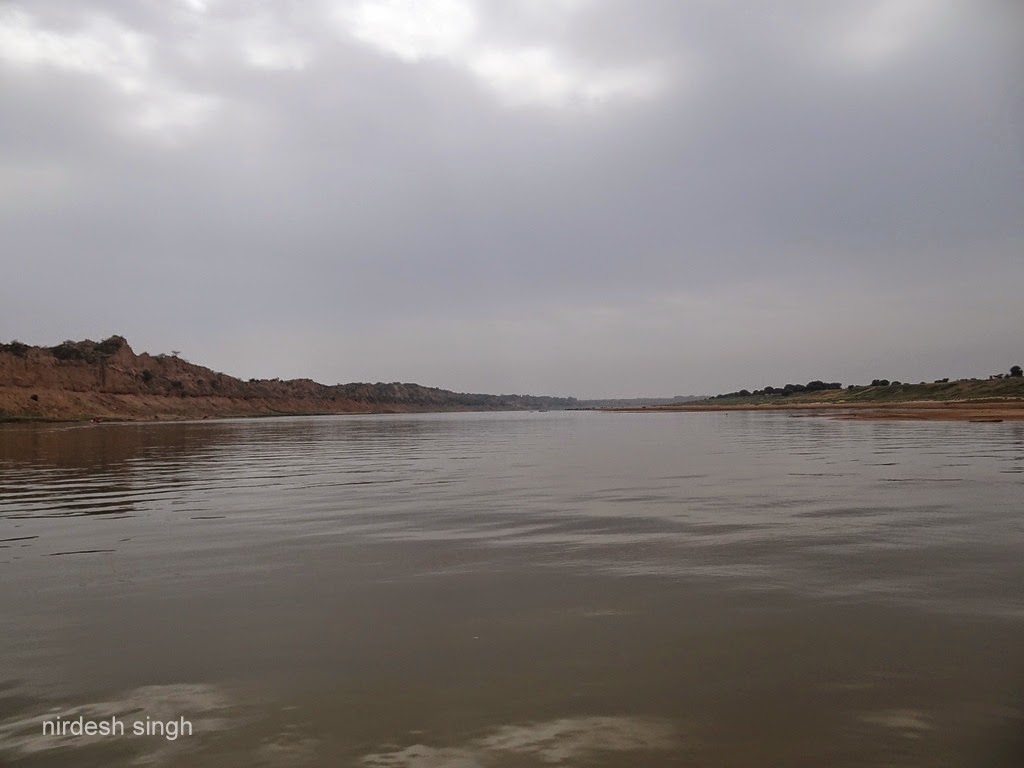
Seeing the wisp of an oily stinky trail that Yamuna is, it is always a marvel looking at rivers that actually look and feels like rivers. Chambal is alive; the water is actually clean and flowing. The centuries old curse and the river being ‘unholy’ probably saved the river. Later the baghis ensured that the river remained out of bounds. The perennial river with pristine water is a marvel while Himalaya fed Ganga and Yamuna are dying. As you glide over the calm waters, it is difficult to imagine that these gentle lapping waters could have seen so much blood, death, terror and revenge.

We head westwards where chances of sighting gharials and crocodiles are more. Yes, Chambal is known for its Gharials. Gharials (Gavialis gangeticus) belong to the crocodilian family and are distinguished by their long snouts. Gharials were found across India but now about 235 of them survive in the world (source: Wiki). The Chambal National Sanctuary is playing its role in protecting and breeding gharials. And here on the banks of Chambal you can see gharials in their natural habitat.

The outboard motor chatters away as we cross the bridge leaving behind a wake. Looking behind you can see the ramparts of Shergarh receeding. It sure is a perfect setting but the bridge and development will ensure the view will not last. On the left, ravine mud walls tower over the river. You can see people on the banks with their livestock. Birds go pecking in the water looking for fishes. It is a cloudy day with sun making an appearance every now and then. Gharials usually come out to sunbathe. Will they come out today?


Mud Ravines providing the perfect bacdrop to Gharials in Chambal


And then the boatman points out two gharials on the left. They are kind of far off. The gharials are shy and disappear into the water seeing the boat or hearing the motor. So the option is either to cut off the motor and try to paddle towards the gharials or use the zoom camera. You try to do both. With the motor off, you zoom in. The boat bobs and it not easy photographing them. The reptiles do look magnificent. Sometimes they will catch the sun and the scaly back would glimmer like gold. They look adorable and are not known to feed on humans. They prefer fish.


Let me find out how tasty those City Slickers are
We move ahead. It is time to eyeball some crocs. It is your lucky day. And we soon find one - this time on the right bank. Now the crocodile does look mean and fearsome. In comparison, the gharials look almost toyish and pet-like. You are not sure how crocs and gharials behave living together in the same waters - is there brotherhood or are they sworn enemies like lions and cheetahs? The crocodile slides into the water – not sure if it felt shy in our presence or suddenly felt like chomping on some city slickers. You keep looking in the water waiting for the croc to emerge under your boat.

Further up are the dolphins. The previous batch of visitors had returned without any dolphin sighting. You ask the boatman to return but not before you enjoy the setting one last time.


Paan Singh Tomar and his Band of Men - Photo Courtesy santabanta.com

This is bliss. The bridge is far behind; we have turned a bend in the river. When the motor dies, all becomes quiet. Birds coo, fishes create ripples in the water. In the distance you can see a group of men wading through the river. That is unmistakably Paan Singh Tomar and his band of baghis. Tall, nonchalant and proud; khaki fatigues, gun over the shoulder. On the other shoulder, a bullet belt is casually slung over. The army training and discipline is apparent. If Paan Singh Tomar, a national steeplechase champion, wanted to, he could have leapt over the river in a single bound. He does not even notice you as you stare wide-eyed. You forget to even get scared. And then the men disappear in the badlands.

India is about films and romanticism. In the deserts of Rajasthan you will see a swaying colorful Yana Gupta resplendent in a mirror dress bring you water in a pot held precariously over her head as lie sputtering to death. Here in Chambal you will see baghis emerge at every bend. Of course, Yana is a figment of imagination as the mirages in desert and here in Chambal the baghis are long gone. Some are dead and some have retired after the government offered them amnesty. Now people prefer to fight their battles in the courtrooms.  

The world around the Chambal has changed little since the times of Mahabharat when Chambal was called Charmanyavati and the Pandavs lost out in a dice game in the general vicinity. Kunti left the baby Karn floating on the river. Draupadi cursed the river and people called it unholy. Dacoits are gone but a new danger is looming that might change the river and the area completely. Mafia is at work dredging the sand, while the mud ravines that give Chambal the unique look, are being leveled. What is wrong with the people today? You just hope Chambal will overcome the modern adversaries too and continue its beautiful and perennial ways into the next century. Next time you will meet Chambal in Kota.


Tuesday, 21 April 2015

Tripping down Memory Lane – My Mother’s Childhood in Dholpur State

Portrait of a Man they don't build any more 

We children have grown up listening to our mother's stories of Baba Saheb from the days when she spent her pre-school childhood years of early 1940s in Dholpur State, Rajasthan. One of the most popular stories was how Baba Saheb would bring back hunted deer and in the evening there was a feast of Deer Pakoras! Of course, she is a vegetarian now. On other days, the bus would be packed up with food for day long picnics by Chambal. While the food was being cooked, Baba Saheb would go hunting for gharials and crocs. The kids would be asked to pose atop the dead reptiles. On other occasions, the Citroen would drive the family for dinner in the lawns of Taj Mahal, sixty kilometres away. And of course, all the childhood pranks mother in company of Baba Saheb’s son would play including crank telephone calling.


Major Kunwar Brijendra Singh of Dholpur State


A Few Good Men


Baba Saheb was my Maternal Grandfather’s Mother’s Brother. In other words, he was my Nanaji’s Mamaji. Baba Saheb or Major Kunwar Brijendra Singh headed the Narsingh (Dholpur) Infantry, Forests, Mines and Zakhira Departments of the erstwhile Dholpur state. Narsingh is the Kuldevta of Dholpur. Baba Saheb's family were Jagirdars who had assumed royalty which continued until 1972. Those days my Nanaji was posted as a Subedar in the Dholpur Army and lived with Baba Saheb. After independence, my Nanaji was absorbed in the Indian Army.

So finally, after all these years it is time to make real connections with the stories. You are in Dholpur and the next morning you visit the Haveli where all the stories took place. My mother last visited the haveli when her childhood friend and Baba Saheb’s son died in October 1995.

The neighborhood Kali Mandir still stands though the construction is modern. On the side of the temple is a Piao. Piao is a modern day water cooler where travelers in the old days would stop for a cool and refreshing drink of water. An inscription says the piao was built by Baba Saheb in 1945.

Next to the piao, the gate opens into an open Bada. And in the middle is the haveli. Kids play cricket in the apparently run-down premises. So while modern construction surrounds the bada, here it seems you have stepped back into time. I can actually see my mother playing in a pram with servants fussing over her.

In the early Sunday morning, I knock on the door and sleepy eyed descendents open the door. I introduce myself and I am led inside. The haveli has an open courtyard with rooms overlooking on three sides. We climb the steps to enter a room which overlooks the Bada. The doorways are real low and I am cautioned not to bang my head.


As we sit and chat, stories come out tumbling: The time when Shah of Iran came to Dholpur to hunt tigers, Baba Saheb who was trying to bring a tiger in play to enable the Shah to shoot; and in the melee the tiger jumped on Baba Saheb who fought with the tiger bare handed. Finally, the Shah was able to shoot the tiger. Baba Saheb returned home all bloodied. Dholpur was a favourite place for the English to come hunt tigers. Englishmen reportedly wet their pants just looking at the approaching tiger as they sat safely high up on the machans while Baba Saheb and his men tried to shoo the cats towards the waiting hunters.

Some Dacoit Kill!

How can we talk about Dholpur without mentioning the legendary dacoits of Chambal. Along with tigers and gators, Major Saheb bumped off so many dacoits that the dacoits declared an reward on his head. As part of plan, a dacoit entered the services in the haveli, but was found out and Major Saheb finished him off.


Those Were The Days - Maharaj Rana of Dholpur (in turban) and Maharaj of Bharatpur


Maharaj Rana Udaibhan Singh of Dholpur

And then the photos come out. All this time I was wishing they would have some. The photographs are Black & White – some are damaged while some are stained. Baba Saheb has a towering personality. I have never seen him before. He looks splendid in full military regalia and that awesome turban. His grandson while speaking to my mother on the phone remarks that I look like Baba Saheb – same height and build! And I figure, even the nose that I inherited from my mother is uncanny! My mother recalls his Amitabh Bachchan like deep baritone voice calling her Bitiya; but mostly his voice scared the kids.


Then there are photos with Baba Saheb posing with felled tigers, cheetahs / leopards and dacoits. Children would be roused from their sleep to come look at the killed cats.

Thank You Letter to Baba Saheb from the Military Secretary to the Viceroy

Invitation to Dinner at Viceroy's House Dated Oct 1st 1945

The British were really thorough - Table Diagram with Seating Order on the Invitation Card - Baba Saheb is seated on the table along with Maharaj of Dholpur


Farewell - To the Viceroy or British?


More folders and albums are brought out. I can see old British correspondence including invitation cards.

 Invitation to Wedding of Maharaj of Bharatpur

 Invitation to the Wedding of Rajasthan CM Vasundhara Raje to Maharaj Rana of Dholpur dated Dec 13th 1972
Apparently, the current Rajasthan CM Vasundhara Raje who belongs to Scindia family of Gwalior was married into Dholpur Royal Family.

All this is so overwhelming. My mother who was the first child in the household was Baba Saheb's favourite and he doted on her. He thought of her as his lucky mascot when his own kids arrived shortly thereafter. When my mother lost two fingers in a freak fodder machine accident, it was Baba Saheb who issued an ultimatum to the doctor; he will weigh the doctor in coins but the little girl should not lose the fingers. The middle two fingers were reattached though they are a little crooked now. 

For a change walking back in to the past is so joyous. I ask the family members to scan the photos and the memorabilia before it is lost. I also ask them to document the stories and life of Baba Saheb. His life certainly deserves a book. They don't make like him anymore. There is a talk to build independent houses for the different families. Maybe by the next time you come visiting, the haveli will be gone and some horrendous modern construction will come up as what is happening in the neighborhood.

In the days after coming back from Dholpur, I am still trying to thread together the pieces. Phone calls with Dholpur and seeing my mother excited like a child is priceless. Dholpur has been a revelation both in terms of heritage and personal connection. On tripping days like these I truly feel blessed. 

Photos Courtesy - Kunwar Vishwajeet Singh Rana

Wednesday, 7 May 2014

Ater Fort - Into the Deep Ravines of Chambal

If Morena was not scary enough for an average traveler, you are now driving towards the ravines of Chambal in the neighbouring district of Bhind. Of course, Morena was a harmless revelation and it magically surprised you with the triple marvels of Bateshwar, Padhawali and Mitawali temples. You are on a new mission - to see the Ater Fort deep inside Bhind on the banks of Chambal.


Ater Fort 

Fields of Bajra - On the way to Ater
Ater Fort Rising
The road from Porsa in Morena to Ater in Bhind was being laid and the ride was painful and slow. Only the green fields all around helped ease the pain. Rivers everywhere with good canal system has turned the Chambal area into a granary. Friendly people on the way ensure that you keep heading the right way. And then as you negotiate another turn on a stream bed with ravines on both sides you see the Ater Fort rising on the horizon.
 
Ater Fort Map
Ater Fort - The Towering Ramparts
Ater Fort - Entrance Gate
Just before the Ater town, about 2 kms south of Chambal river, you make a final left turn and arrive at the fence gate of the fort. Except for roadside shop owner across the road there is nobody around. You leave the car in his care and enter the grounds. The entire area is quiet and desolate. The fort walls tower over us on the left. They must be about 20 m high. As the ground is relatively plain apart from the mud ravines around, the walls and the intermittent seventeen bastions provide the defense to the fort. The walls have watch posts built on top that turn out to be pavilions later. You walk around the ramparts following the dirt track until you arrive at the entrance gate which could be the north–west gate. First signs of life in the fort are detected here. The caretaker is surprised to see us and gives us some general directions but is considerate enough to depute his colleague to accompany us. This caretaker brandishes a mean lathi. He douses our concern by saying one word – snakes! You are in Bhind and the visit will be incomplete without a fear factor – if not dacoits, snakes will do just fine. You are glad that you are donning tough shoes and jeans.

When you first heard of the Ater Fort, it was a complete blind spot. But if you are within easy striking distance then you have to go see it for yourself. There is not much information available about the fort. At the fort entrance there is the brief introduction to the history of the fort. Inside there are no signs to identify the different buildings. It will be a challenge to piece together some background of the fort.
 
Ater Fort - The Third Gate
Ater - Diwan-i-Aam
The fort generally is crumbling. ASI seems to be doing some patch work to help the fort hold on to some of its past grandeur. After passing through the red sandstone third gate and then turning left, you enter the gates of possibly the Diwan-i-Aam or Hall of Public Audience. There is not much here with the courtyard in the middle and ruined walls all around. Facing the gate on the east is a jharokha with bangla roof where perhaps the king sat during the proceedings.

Ater Fort - Diwan-i-Khas

Saatmanjila and King's Throne

King's Throne with Ornamentation
Octagonal Platform in the Diwan-i-Khas
Moving ahead to the left brings you to the most intact and majestic area. This is the the Diwan-i-Khaas or the Hall of Private Audience. The east side has a raised recess with stucco walls. The balcony with the bangla roof is the throne of the king. The ceiling has some pretty ornamentation which has now faded. You have seen similar bangla roof canopy at the Diwan-i-Aam at Red Fort in Delhi. Apparently the architecture is inspired from the Mughals. Below the balcony on the ground is a ruined octagonal platform that had marble and other colourful stone embellishments. Above the King’s seat, dwarfing the courtyard rises the tower called Saatmanjila. Just opposite the king’s balcony, across the courtyard, on the west side is another balcony where perhaps the nobles sat. The courtyard has a small pool in front of the noble’s balcony. Today the pool is filled with water from the recent rains.

Diwan-i-Khas - View from South Baradari
 
Inside South Baradari
On the north and south sides of the open courtyard are the dilapidated baradaris and rooms. On the first floor on either side you can see graceful pavilions. It is time to explore the tower and the pavilions.
 
Floral Motifs
View from Satmanjila

Chambal on the Horizon - Another View from Saatmanjila
As you gingerly pick your way up the tower, you see colour paintings and panels. Most of the places the original stucco work has fallen off leaving little patches of colour. As you climb higher you can see the fort complex and the grounds beyond in all directions. In the north, beyond the town, you can see the Chambal river. Here in the fort, to the east are the ruins of private quarters or palaces of the king and the queen.

Ater Fort - North Pavilion

The Best Place in Ater Fort

Makarmukh on Rood of Pavilion
Beautiful Mural in North Pavilion 
You come down to the first level to see the pavilions up close. The pavilions sit at the edge of the platform at the top of the fort ramparts. With projected balconies the pavilions provide a pretty picture. These are the watchposts you saw on the ramparts. On the roof  you can see a crocodile face hanging from the edge. This must be the Makarmukh and the face is that of a gharial. Gharials, a family of small crocodiles with narrow snouts are found in the Chambal river. Just below the overhanging snout is a bracket with a hole where perhaps the kingdom’s flag was unfurled. The gharial makarmukh is the ideal image as Ater is gharial country and crocodile is the preferred vehicle of River Ganga and God Varun. The gharial makarmukh doubles up as Somasutra or water run-off point. Inside the pavilion, there are paintings on the walls depicting the royal couples. Cool breeze flows from the Chambal through the jharokhas. Large terrace spreads out in front overlooking the courtyard.  This is the best part of the fort to spend some time with yourself.

The pavilions outside have inscriptions dated 1765 and1776 with the names of Scindia Rulers who later ruled Ater - Mahadji,  Daulat Rao, Jiwaji Rao and Madhav Rao. One inscription says that the pavilion was built by Sidhi Shri Maharajdhiraj Shri Maharaj Vasat Singh Judev in Samvat 1822 in the Paush month.

View of the Palace from first level
The caving roof of the Palace
You come down to see the palace area. Like the audience halls, the palaces are also designed around courtyards. Most of the structure is in bad shape and the caretaker does not want you to go in the verandahs. The heavy stone slabs holding the roof have cracked and it is matter of time before the entire structure collapses. There are heaps of debris all around - restoration if done will be time consuming and costly.
 
Ruins amid Ravines
This is the tragedy of having plenty. Out here in the badlands, where a tourist is as rare as a dacoit, why would an agency spend funds to restore a fort when it knows it will not get any returns on its investment. A possible solution could be the development of the area into a tourist circuit that could include boat ride over the Chambal, visit to the Gharial Sanctuary in Morena, climbing the Saatmanjila in Ater Fort and then onwards to the three temple marvels of Morena.
 
Bhadorias at their peak
The Ater Fort was built by the Bhadoria rulers. The dynasty is believed to have been established in 8th century by Raja Chandrapal Dev and derives its name from his son Raja Bhado Rao. Later Bhadoria kings fought with Delhi Sultan Qutbuddin Aibak and also partnered with the Mughals. This region called Badhwar has a strategic location where five rivers including Chambal and Yamuna meet. King Badan Singh started the construction of Ater Fort in 1644 and King Maha Singh completed it in 1668. Badan Singh also built the Bateshwar Temples on river Yamuna in Agra District. In addition to Ater Fort, the Bhadorias also built forts at Nawgaon, Pinahat and Hatkant. At their peak the Bhadorias had a kingdom extending from Gwalior in South, to Dholpur in West and Mathura and Kanpur in East. The Scindia rulers captured the fort in 18th century.
 
Chambal Boat Ride - courtesy Vipin Gaur
Sunset in Bhind 
If you are feeling adventurous, then drive through the town to reach the banks of Chambal river. On the river you can take a boat to cross over to the other side into Agra. The sun is about to hug the horizon. After all this is Chambal. You take one last look at the proud and towering walls of the Ater Fort rising over the mud ravines and leave for Gwalior. You only wished that you had been able to identify the Khooni Darwaza, Badan Singh ka Mahal and Barakhamba Mahal!


Getting There: You can reach Ater by making either Morena or Gwalior as your base. Ater is 90 kms from Morena and 110 kms from Gwalior via Gohad and Bhind. For adventure seekers, Ater Fort can be reached from Bah in Agra district and crossing the Chambal River on a boat!

Please visit youtube video: