Malik Kafur, the feared general of Delhi’s
Sultan Alauddin Khilji swept
across South India and annexed Warangal in 1309. In 1310, the old capital of
Hoysala Ballalas at Dvarasamudra was taken. After an expedition deep down to
Madurai, Malik Kafur
returned to his master with a booty loaded on 312 elephants, 20000 horses that
included ten crore gold coins and a certain diamond
known as Kohinoor. Six years later, prince of Devagiri
– modern Daulatabad – Haripal Deva was killed by Mubarak
Shah Khilji of Delhi. In 1323, Kakatiya’s Warangal fell. Entire Northern India and Deccan
upto Krishna River was under Muslim rule. The ancient
Hindu kingdoms of the south like Pandyas, Cholas and
Cheras were probably quaking in their boots. Muhammad
bin Tughlaq, eccentric and cruel, ascended the throne
of Delhi in 1325. The quaking just got ratcheted up a few notches on the Richter
scale. It seemed it was a matter of time before the remaining Hindu kingdoms
would be subjugated and laid to waste.
 |
| The Blissful Anegundi Fort |
In his celebrated book ‘A Forgotten Empire
(Vijaynagar)’, Robert Sewell says that after the incessant march of Muslim rule
south of Vindhyas and Deccan, suddenly in about 1344 there was complete halt to
the wave. The check was caused by three small Hindu states: Warangal and Dvarasamudra
that were already defeated; and the third was the tiny Anegundi which
ultimately grew into the mighty Vijaynagar empire. The southern kings submitted
to this empire.
Dvarasamudra, 300 kms south of Anegundi, is the
modern day Halebidu and a tourist magnet for the magnificient Hoysala temples.
You missed this connection completely when you visited Halebidu last. Anegundi
and Dvarasamudra will always be overshadowed by Hampi and Halebidu in the
modern traveling context. Warangal, in Telangana, with its devastated fort and Thousand Pillar
Temple is about 600 kms north east to Anegundi.
 |
| Remnants of Anegundi Citadel Walls on the left |
 |
| Surviving Anegundi Citadel Walls on the Rishyamukha Hill |
In about 1330, taking advantage of the incredible
geographical feature of granite boulders piled high into loose hills, a family
of chiefs, probably feudatories of Hoysalas Ballalas, built an immensely
fortified citadel nestled in the hills and protected by the mighty Tungabhadra
in the south. And so begins the journey of Hampi (Vijaynagar) from this
unassuming small village of Anegundi. Firishta believes that the chiefs had
existed as a ruling family for seven hundred years prior to 1350 AD.
Sewell further says, that looking from the Hampi
side, he would see the Anegundi citadel fortifications running across the hill
but never got the chance to cross the river and explore to prove Firishta
right.
 |
| Anegundi Country side |
Let us go back into time to see how this
happened. According to Sewell, there are several versions. Tughlaq, after
overrunning Gujarat, marched southwards against his rebel nephew Baha-ud-din
Gushtasp who had taken refuge with the king or Raya of Kampli. Kampli is a
small town about 25 kms from Hampi. Raya sent the nephew to Dvarasamundra and
himself shifted to Anegundi where the chances of defending against the Sultan
were better. The year was possibly 1334. Raya was killed, the fortress of
Anegundi seized and his eleven sons taken prisoners and converted to Islam. The
Sultan chased his nephew southwards, skinned him alive and had his flesh cooked
with rice. The skin was stuffed with straw to be exhibited throughout the
country along with the identical remains of Ghiyas-ud-din Bahadur Bura of
Bengal. Tughlaq certainly had his soft side.
Back in Anegundi, the Sultan left Malik Naib as
the governor and probably came back to Delhi. He was missing the daily
spectacle of trampling of denizens by elephants at his swank Hazar Sutan palace
in Jahanpanah Delhi. Anegundi’s local population rose against the usurpers and the
kind hearted Tughlaq restored the kingdom back to Hindus by installing Deva
Raya as the Raja and his brother Bukka as the Chief Minister. In 1336, Deva
Raya or Harihara Deva I founded the city of Vijaynagar on the other side of the
river with the help of great religious teacher Madhav. The river along with the
boulder hills would provide better protection against the marauders from the
north. Bukka succeeded Harihar and ruled for thirty seven years. This version
is almost true since we know Vijaynagar was established by the brothers Harihar
I and Bukka and the third king was Harihar II, son of Bukka.
Other accounts say that the brothers Bukka and
Harihar, were in the service of king of Warangal and escaped to Anegundi when
Warangal was attacked in 1323 and were accompanied by the Brahman Madhava or
Madhavacharya. Another account says that the brothers were officers of the
Muslim governor of Warangal who were part of expedition against the Hoysala
Ballalas. The brothers’ battalion was probably defeated and they fled to
Anegundi where they met the recluse Madhava and established the empire. Still
other accounts say that the brothers were feudatories of Hoysala Ballalas,
while some accounts say it was the hermit Madhav himself founded the city of
Vijaynagara.
To put things in perspective, Ibn Battuta was
visiting India during these years of 1333 to 1342 and was a member of Tughlaq’s
court. The first account of the Raya being slain and his sons converted has
been corroborated by Battuta who seemed to have met them. This is getting
interesting as you have already covered these events in a post on Delhi’s
Fourth City of Tughlaqabad; same Tughlaq guy – eccentric, tyrant and smart - now
playing in a parallel new arena.
So what happened in the year 1344? Apparently,
Krishna Naik, son of Rudra Deva of Warangal, Ballala Deva of Dvarasamudra and
Bukka combined to first free Warangal. The Muslim governor Imad-ul-Mulkh
retreated to Daulatabad. Soon other kingdoms of the South joined and Muslims
were expelled from Deccan. The southern kingdoms reportedly submitted
peacefully; perhaps just glad to keep the foreigners out. The tiny principality
of Anegundi gave birth to the kingdom of Vijaynagara that soon expanded to
become an empire. Abdur Razzak, an envoy from Persia who visited in the early
1440s, reports that Vijaynagara stretched from sea to sea and from Deccan to
Cape Comorin heading an army of eleven lacs troops.
All Muhammad-bin-Tughlaq was left with was
Daulatabad. The peace would be short-lived. Soon the Vijaynagar rulers will
have to contend with the Deccan Sultanates that formed after revolting against Delhi
Sultanate in 1347.
 |
| View from halfway up the Anegundi Fort |
Enough of history - now let us go see what Sewell
missed seeing from the other side of Tungabhadra. You drive west from Anegundi
village. On the left rises the hill called Rishyamukha where Sugreev lived.
These are the most interesting hills you have ever come across – the hills are
simply made of huge piles of boulders loosely balanced atop each other.
 |
| Steps leading to Durga Temple and Anegundi Fort |
 |
| Hanuman Temple around the first bend in the walls |
 |
| Second Level of Fortifications leading into Durga Temple |
The first line of citadel walls can be seen as
you drive around Anegundi area. These are the walls which Sewell looked at
wistfully from across the river. A short steep ride brings you to the base of
the hill with a parking spot and a kiosk selling drinks and snacks. This is
when you discover the simple trusting life of a small town. The kiosk owner has
to go run an errand. Your driver Muniswamy is deputed to take care of the store
while he is gone – amazing; you doubt you will see something like this in a big
city. You take in the sights looking eastwards at the waters of Tungabhadra.
It is time to climb the Rishyamukha Hill. The
steps wind around the boulders on both sides. You encounter the first
fortifications. Here you turn left into a narrow doorway which probably later
has been converted into Hanuman Temple. Up ahead, the path turns right into
second line of fortifications. Here again the gateway is guarded by imposing
square bastions.
 |
| Durga Temple on way to Anegundi Fort |
You cross the gateway to enter into the courtyard
of the Durga Temple. The temple and other subsidiary buildings are all of
recent construction. The best feature is the big tree with colorful strips of
clothes tied around its branches holding coconuts as good luck charm.
 |
| Boulder strewn path leading to main gate of Anegundi Fort |
 |
| Anegundi Fort |
 |
| Anegundi Fort - View from Main Gate |
Just beyond, a boulder strewn path takes you to
the main entrance of Anegundi Fort. Now this looks like a fort that you are
familiar with. Tall imposing bastion like circular turrets guard the low
gateway. The turrets are topped with kanguras or crenellations. On the top of
gateway, a projecting balcony looks over the approach path. Guards probably
kept an eye on the visitors here. You haven’t seen these architectural elements across Hampi. Were these constructed by the later Vijaynagar kings after the
Battle of Talikota or were they constructed by the Deccan Sultanates? You are again
not sure if the sultanate stayed back here or went back to their infightings
and regular skirmishes with the Mughals.
 |
| Anegundi Map |
 |
| Looking back at the Main Gate of Anegundi Fort |
 |
| Interestingly Placed Boulders |
 |
| Sliced Boulders and looking towards Main Gate |
Beyond the main gate a path takes you straight
into the fort. Surprisingly this is a comparatively flat stretch of
land. On the right, boulders interestingly placed over each other create a
possible watch tower.
 |
| The Pushkarni in Anegundi Fort |
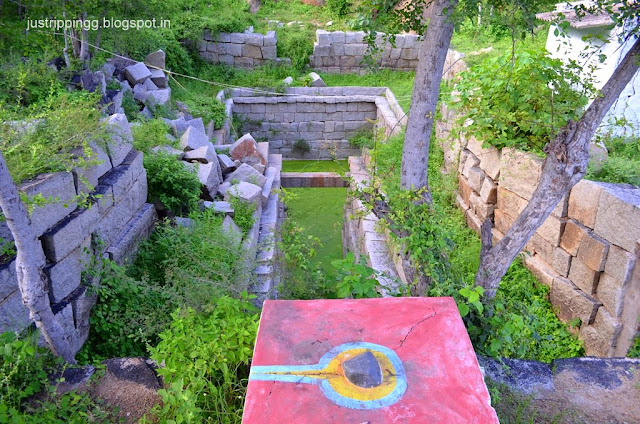
On the right is a small pushkarni or a stepwell.
Water bodies are a feature of all forts across India. During times of siege,
these water tanks sustained the inhabitants of the forts.
 |
| Looking towards Vaali Cave where Vaali fought the Asur and locked in by Sugreev |
For the first time, you encounter people in the
fort. There is a local visitor and the priest. You exchange pleasantries.
People are always intrigued with a person from far off Delhi in this neck of
woods. Just beyond on the right, boulders create a cave with a temple. The man
informs this is the Vaali Cave - Vaali Cave, really? Now this is a surprise.
You have missed seeing the Sugreev Cave on your walk from Hampi Bazaar along
the Tungabhadra towards Vitthal Temple. It is believed Vaali fought a duel with
Mayavi asur in this cave and which was sealed off by Sugreev when he saw blood
pouring out. In your excitement, it seems you forgot to take a close-up photo
of the cave.
 |
| Standing Ganesh image with wife Siddhi |
The priest further informs that the cave has a
Hanuman Temple which is facing South. Usually Hanuman Temples face North. It
could be unusual but not rare. Inside, there is standing Ganesh image with his
wife Siddhi on left. The priest believed that standing Ganesh is also rare and
usually Siddhi is not seen. Iconography is not really your forte. And in
matters of faith, reality is a casualty. You have no way of actually validating
if this is Vaali Cave and if the idol dates back to Vijaynagar times.
On the left a ruined gateway can be seen with the
arch built of bricks. The Gagan Mahal in Anegundi village was built of bricks.
You do not remember seeing brick arches in Hampi though the shikars of temples
are built of bricks. Again, you are not sure how old this structure is.
 |
| Construction material for Vijaynagara Empire |
 |
| Closely-spaced series of holes along which the boulders were sliced |
And then you see these boulders that have
serrated edges. You have seen such sliced rocks across Hampi and Chitradurga. There
was no need to gouge out hills. The loose boulders provided easy construction material.
To break rocks, the workers drilled small closely-spaced series of holes in the
rock. By gently tapping iron pegs wedged into the holes, the workers were able
to split the rock precisely where they wanted. Water poured into the holes
helped split the rock more easily. Sometimes instead of using iron pegs, the
rock was gently wedged apart along the line of holes. So simple and so
ingenious.
 |
| Ramaraya's Samadhi? |
Coming back towards the main gate you turn right
to investigate. Within an enclosure you see few mantapas. One has only the
pillars standing. The one behind survives with a seemingly later built parapet
on top. The third mantap looks like of modern construction. The mantaps were
possibly tombs or samadhis. Is it possible that one of these samadhis is of Ramaraya,
the son-in-law of Krishna Devaraya? Tiny dolmen like structures have been
erected by worshippers for good luck. You were mystified to see such rock
arrangements at the Ajaigarh Fort in Panna MP.
 |
| The Surprise - Circular Structures |
Walking further into the thick shrubbery brings
you more surprises. Hidden here are three circular plastered structures built of brick and rubble. While one is in
good shape, the other two are ruined. Arched windows can be seen in the
structures. You don’t know if there is a window on the other side too. Now what
can these structures be? Are these tombs or guard chambers? They do not seem to
belong to Vijaynagara architecture. Rubble masonry and plaster was not
Vijaynagar’s style. Were they built later by the sultanate victors?
 |
| Zone of Bliss in Anegundi Fort |
On top of the Ramayana’s Rishyamukha Hill, in
Anegundi Fort, built by founders of the Vijaynagar Empire, hidden among trees
with no one around, you find yourself in zone of bliss. Butterflies flit and
charm, wispy clouds float in the blue sky, branches with flowers sway in the
breeze - a moment when you are lost from the world. For company you have these
strange looking structures and a crumbled stone mantap. It cannot get better
than this. You want to stay here and stay lost to the world.
 |
| On Your Way Out |
It is time to wrench yourself away and start the
walk back into the world. In a few hours you will be in another zone of bliss.
Anegundi’s middle name is Bliss.
 |
| On the Way Down |
You come back to find two foreigners sipping aerated
drinks while Muniswamy is still commandeering the store. You need a drink
yourself after the climb. After making some small talk, the fellow visitors drive
off on their rented mopeds. This is the way to experience Anegundi – stay in
the village, hire mopeds and just drive around. The coracles will take you and
the moped across the river. The store owner arrives; ledger is balanced and
cash handed over. Muniswamy has a surprise waiting for you just beyond. Did you
say you could get used to the life here?
 |
| One Last Look over Anegundi |
Sewell would have been happy to cross the river and
walk around the the fort. Maybe a century ago - his book was first published in
1900 - he probably would have discovered evidence that could have dated the citadel
back to 7th or 8th century. It was these granite boulders
and the citadel that blocked the invasions from the North.
These boulders have seen the goings on for 3000 million
years. Anegundi is perhaps the oldest plateau on Earth. But you do wish that
Vijaynagara, the City of Victory, had stayed unconquered and proud. Standing on
the banks of Tungabhadra, it would have been a marvelous sight to see the
Vijaynagara elephants making their way back to Anegundi in the evening.
Anegundi literally means a pit or enclosure of elephants.
But then who can challenge fate. What Malik Kafur
started with Anegundi, the mother; the Deccan Sultanates ended by killing her
child Vijaynagar. No boulders or fortifications or even the mighty Tungabhadra
could stop the combined forces of the Deccan Sultanate from slaughtering the
child who had grown into the glorious and youthful Vijaynagar. Vijayanagar, the
child is gone but the mother Anegundi still lives on. Wracked by grief, Anegundi
is stoic and dignified. She would not want Malik Kafur to see her tears. Even with her loss, we
want Anegundi to live forever and be blissful always.
Getting There: Anegundi is about 15 kms south east of Gangavathi
taluk of Koppal district in Central Karnataka. Or take a boat or coracle ride
from Hampi side just beyond Vitthal Temple
References:
1.
A Forgotten Empire (Vijaynagar) by Robert Sewell
4.
Cutting Edge Technology – ASI Sign at Chitradurga Fort explaining the
slicing of boulders for use as construction material
Related Anegundi Links on this blog: