Showing posts with label North-east. Show all posts

Monday, 30 April 2018

Mawlynnong – The Floweriest Village in the Whole World


A meandering path through trees and flowery bushes brings you to a pretty house with a sloping roof. The house nestles among more flowers. Whichever way you look, there are flowers smiling. This is the prettiest house you have ever seen – not in the hills or a suburb of a metro but in a village in one of the remotest parts of India bordering Bangladesh. Under brilliant blue skies with the sun spreading warmth on a winter December day, you find yourself in the most beautiful village. 


Tall Broom Grass lining the road to Mawlynnong

You have just driven through a scenic road with tall Broom grass lining the smooth tarred road on your way to Mawlynnong, ninety km from Shillong in Meghalaya. Mawlynnong has an unusually surprising tag especially given the sanitary condition of India’s cities, towns and villages. Oh yes, the cluster of flowers or inflorescence of Thysanolaena maxima or the Broom grass, grown as a cash crop, goes into the making of our household phool jhadu. It will soon have a serendipitous resonance with the fame of the village.


Mawlynnong - India's Prettiest Village


It will come as a surprise to all Indians that Mawlynnong was given the honour of “The Cleanest Village in Asia” by the travel magazine ‘Discover India’ magazine in 2003. Finally, villages of India are enjoying their days in the spotlight. So while Mana village in Garhwal bordering Tibet, is famous as ‘Last Indian Village,’ Kuldhara near Jaisalmer is supposedly a haunted village when the entire resident population deserted it overnight and the Heritage Crafts Village of Raghurajpur in Odisha has artisans in every household practising the ancient art of Pattachitra. Back here in the North-East, Mawlynnong is basking in its unique title; an epithet later echoed by BBC, UNESCO and Nat Geo.


Mawlynnong Scenes: A House in the prettiest setting

Yes, the village is squeaky clean – okay the cleanest and the most beautiful village you have ever been to. The greenery is everywhere, flowers glow in the sun and a gentle refreshing breeze tiptoes through the village lanes. Coming from smoggy Delhi, it is hard to imagine that something basic like breathing could be so nourishing and refreshing. Now that you notice there are these bamboo conical basket cases, locally called khoh, that are supposed to be trash bins.  There is no litter to be seen anywhere; there are no polythene bags or chip packets flying around. It is unbelievable that such a place actually exists in India. And it is so serene here. Except for the laundry drying in the sun, the simple houses built of bamboo, wood and metal sheets seem to be empty. Once in a while a child walks out smiling trying to evade the camera of a prying tourist!


The Beautiful houses and paths of Mawlynnong


The village did not turn pristine overnight. The residents of the hundred year old village always remember the village this clean with the cleanliness habit being handed down over the generations. Children are taught to keep their surroundings clean. Each house has a toilet and there is no open defecation. It is only the tourists like us unaccustomed to clean ways who might throw packets or wrappers around. The village with a population of 500 and 90 families though has seen some changes; few cement houses have been built, roofs have satellite dishes and the cobbled streets have turned into concrete paths but the cleanliness ethos have remain unchanged.


The bamboo waste baskets can be seen along the village paths


Long before the Prime Minister launched Clean India Campaign, the inhabitants of Mawlynnong with 100% literacy were already practising cleanliness. The village council governs this community effort where polythene and smoking are banned and the streets are swept by the residents themselves. The kids pitch in by picking any dirt and dropping it into the baskets before going to school. The organic waste is collected and turned into manure which is then used to grow organic produce. Mawlynnong’s headman was thrilled with the recognition when the PM lauded the village’s efforts involving the citizens in keeping their village clean during his monthly Mann Ki Baat program on radio.


The Beautiful Cosmos flower


The village along with being the cleanest is definitely the floweriest village in India.  As in a trance, you walk through the lanes in complete joy and awe. Flowers, ornamental shrubs and tall areca nut palms line the alleys covering every inch of the landscape. The feeling is almost similar to when you walked through the flowery canvas of Valley of Flowers in Uttarakhand. Canary yellow Allamanda, the heart achingly beautiful Cosmos set against the blue skies, purple and white Flamingo Feathers, Golden Shrimp, never seen before Pink Jacobinia, the stunning Scarlet Clock Vine and the ethereal Bleeding Heart Vine made to adorn the hair of princess all come together to create a magical garden where you want to dance and sing with abandon.


Every which way there is an astounding variety of happy flowers in all colours – swamping the lanes, hanging like garlands from eaves, in pots and in the small gardens around the houses. It seems the village started as a large garden. The houses came later and now are just incidental. Mawlynnong is definitely ‘God’s Own Garden!’


The Wonder Rock at Mawryngkew; on the way to Mawlynnong

Mawlynnong, in a remote corner of this incredible country, is a perfect stop to spend a couple of days soaking up the Khasi culture. The village has several homestays. One of these houses offers you a delicious vegetarian lunch. A guesthouse built of bamboo provides tree-top accommodation along with an unmatched experience. The ‘Sky View’ has a viewing gallery built high on top of trees that offers views of plains of Bangladesh. At Mawryngkew, on the road leading to the village, a huge Balancing or Wonder Rock incredibly balances itself inches above the ground on a tiny stone below.


The Living Root Bridge of Riwai

The biggest surprise is two kilometres away in the village of Riwai. Here you actually get to walk on a Living Root Bridge (Jingkieng Jri), a bioengineering feat, across a stream. A living root bridge is an ingenious way of connecting communities across the criss-crossing streams in these remote locations especially during monsoons when the streams turn into swollen frenzy. The bridge is formed by training the aerial roots of rubber trees (Ficus elastic) through the hollow trunk of areca nut palms on either side to span the width of a river. It might take years before the intertwined and complex web of the living roots become strong enough to carry the weight of people. Some of the bridges are over hundred years old. So while the conventional steel and concrete bridges become weak over the years, these breathing and growing root bridges become stronger.


Mawlynnong - Blue Skies and Yellow Flowers

In Mawlynnong, do not think much about what to see or do; simply walk the village lanes. The flowers, the greenery, the tall swaying palm trees will keep you wonderstruck all day. The sheer variety of flowers is incredible. The cold winter afternoon has never felt so crisp and perfect. Few minutes of this experience is guaranteed to lull you into a sweet stupor. You wish, just like in the Haryana villages, there was a chaupal here too, so that you could have just pulled a charpai and napped sprawled under the gentle warm sun.

As the soft sun caresses the flowers and the smiling kids flit around like butterflies, you realize this is an experience that can be easily replicated across our villages and cities. We would all love to live in clean surroundings among flowers. All it takes is some community spirit and resolve. Mawlynnong does not need to feel like a foreign country. We together can make more Mawlynnong flowers bloom across our country.

Getting There
Mawlynnong is located in the East Khasi Hills about 90 kms south of Shillong in Meghalaya. The two hour drive is pleasant offering amazing views of mountains and narrow winding road through clumps of bamboos and broom grass.

Hiring a taxi from Shillong is a good idea for the day long excursion unless you want to stay over in Mawlynnong in one of the several homestays. In that case, you can check with Meghalaya Tourism’s bus services that can drop you here. The office is in Police Bazaar, downtown Shillong. The Meghalaya Tourism buses only run if they get minimum 10 or 15 passengers. You can leave your phone number with them and if they get enough people by the end of the day, they will call you to make payment. Alternatively, you can take shared jeeps from Bara Bazaar with a stopover at the midway point Pynursla.

When in Mawlynnong
Hire a local guide who can take you around the village. Stay in one of the homestays and mingle with local families. Go trekking on several trails that lead to neighbouring villages and beyond along stone pathways called the King’s Way. Visit a neighbouring Sacred Grove which are forests protected by the local communities and are believed to be the abode of deities. The groves are a treasure trove of plants, trees and animals.

A version of the story appeared in the Winter 2018 edition of Namaste - magazine of ITC Hotels.

Namaste - The ITC Hotels Magazine


Related stories on this blog


Saturday, 17 December 2016

The Ephemeral Cheery Cherry Blossoms

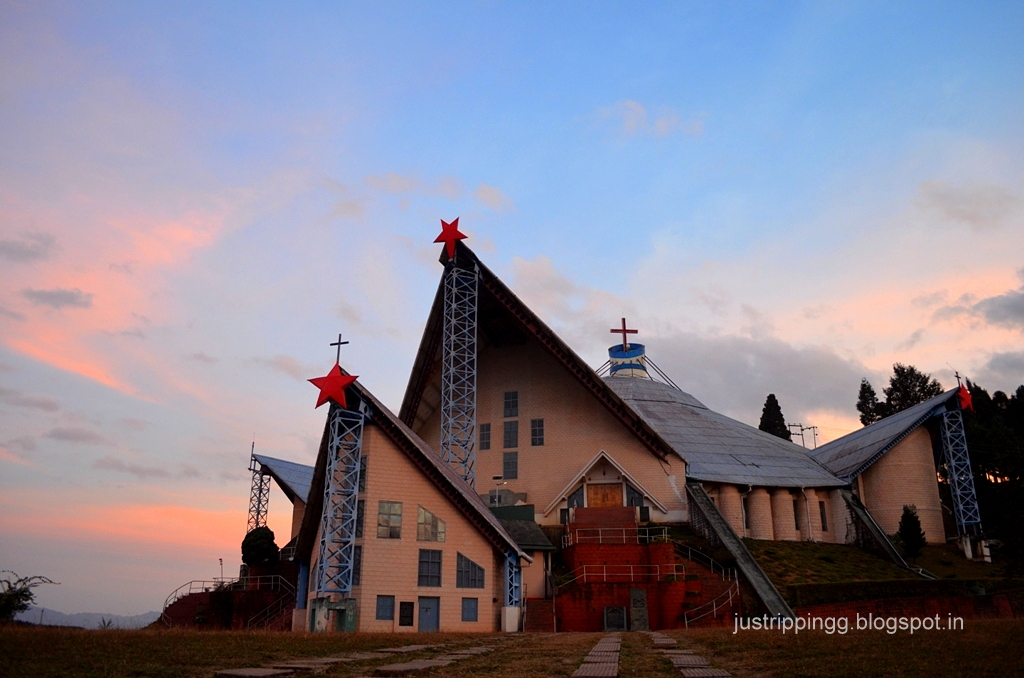
Kohima Delight: Of Cherry Blossoms at Catholic Cathedral

“Are these Cherry Blossoms?” I blurt out to nobody in general. The pink jewel like flowers adorning the branches of this tall tree have left me stunned. Transfixed to the spot, I stand with my mouth agape.

A mother-son duo is passing by. The little kid is bouncing along; like kids do, instead of walking.

“Yes, they are Cherry Blossoms!” The toddler chirps with a twinkle in his eyes. The mother smiles proudly.


The Ephemeral Cherry Blossoms of Kohima
Now I am smiling too. For a minute, I take my eyes off the jewel studded tree and shake hands with the little guy. It is my first day in Northeast India and I am already in love with the beautiful and smiling people. The mother and her son walk away, waving at me as their smiles light up this beautiful crisp winter day.

This is the beauty of India. You can prepare as much as you want, but there are always pleasant surprises that no amount of research can ever prepare you for. All I remember is seeing some photos of the beautiful Cherry Blossoms or Sakura flowers of Japan. Kohima has a painful association with Japan when some of the fiercest battles were fought during World War II between British India and Japanese troops right here in the hills. Today, I just found the most beautiful association. The cherry flowers seem to be Nature’s way of applying a soothing balm on the now healing wounds. 
The Twinkling Stars - Cherry Blossoms
The Catholic Cathedral of Kohima, Nagaland
To this day, I am still bewildered, how my brain was able to dig out the name of these glorious flowers from the deep recesses within, when the only flowers I can possibly identify are the roses! Maybe that is the magic the blossoms cast on the onlookers. I am walking from the Minister Hill to the Aradura Hill that houses the grand Catholic Cathedral when I encounter my first cherry tree and the kid. Little distance away, the church premises have more cherry trees blossoming. 

Britain says that in the history of British Army, the greatest battles of WWII were fought right here in Kohima and Imphal during the spring of 1944. Walking on the Aradura Spur today, I can only imagine the scenes of bravery and horror that were played out and inflicted upon. Thankfully, the guns have fallen silent now. The pleasant looking imposing Cathedral is built in the traditional Naga style and is the main Church of Nagaland. At sixteen feet, the crucifix carved out of wood is India’s biggest crucifix. The church commemorates the fallen soldiers during the battles. An inscription here says that the church has been built with the contribution of Japanese survivors and bereaved families who lost their loved ones during the spring of 1944.
The Cathedral during the blue hours
Today the church premises resemble a wonderland. Set against the cobalt blue skies are the pink jewels shimmering in the sun’s rays. It is not easy looking up the cherry trees so I lie down on the embankment to better admire nature’s miracles. Now that I realise, I haven’t seen such blue skies in a long while. Delhi gets such skies maybe five times a year while for the rest of the year they remain grey and forbidding. But then Delhi has its own flowery marvels when you discovered the evanescent Silk Floss flowers last autumn.
-------------------------------------------------
Related Links on this blog:
http://justrippingg.blogspot.in/2016/08/northeast-sojourn-beauty-beyond-compare.html


http://justrippingg.blogspot.in/2016/08/love-at-first-sight.html
------------------------------------------------

The smile continues to play on my face. The gentle sun’s rays dance through the swaying branches as I am treated to a celestial event. The flowers high up don several avatars; sometimes they look like jewels and pink snowflakes and then they twinkle like stars.

In Japan, the Sakura (Prunus serrulata) blooms in April for about two weeks. The entire country waits for the whole year looking forward to the annual spectacle.  And when the trees finally bloom, Japanese families gather around the Sakura trees to participate in an ancient ritual called Hanami, which basically means flower watching. Here in Kohima, the cherry tree is a deciduous tree (Prunus cerasoides) which is found in Himalayas and Southeast Asia and flowers in autumn and winters. To me the flowering time seems to be perfect as it coincides with the Hornbill Festival which starts the next day. I will soon discover that the Hornbill Festival, just like these cherry blossoms, is nothing like I have ever witnessed before.

Below the pink cherry blossoms, the red and vivacious poinsettias smile in their full glory. God has intended my first day in Northeast to be full of wonderment. After soaking in the cherry blossoms, I walk around the lawns of the church. The maintenance is immaculate and it seems there is an entire world of flowers here. Tomorrow, Kohima will treat me to more cherry blossoms at the WWII Cemetery and in Kisama.


Up here, on top of the Kohima city, away from the noise and dust, it is absolute bliss. Tiptoeing around the beds of flowers I am reminded of the Valley of Flowers in Uttarakhand. Fresh looking pink and white cosmos flowers seem to be basking in the soft sun. First it was stars on the trees and now among the cosmos flowers, I seem to be walking in the cosmos itself. The contrast of the tender cosmoses with the vibrant poinsettias is breathtaking.
The City of Kohima spread on the hills
Walking around the Church I come to the edge of the hill. Another exhilarating scene comes into view - Kohima city is spread out below.  This is surreal. Descending rows of flowers seem to meet the city just beyond. The views, the blue skies and the cherry blossoms all combine to give me the delicious feeling that I have ascended into the heavens. This is the place to enjoy the evening and see the sun go down. 


Evening comes early in Northeast. The western skies are inundated with clouds that change their shapes even as the skies take on different hues every passing minute. Every sunset offers two views: one view is looking towards the red ball of Sun sinking into the ground and the other view is right behind as the landscape gets doused in the golden colour with Midas busy touching and turning everything into molten gold. Another wonderful day is coming to an end in this ephemeral life.


Cherry Blossoms, while exhilarating us with their sublime beauty, also teach us something profound. Cherry Blossoms are known to be ephemeral and transient. They teach us that things in our lives that we take for granted are essentially transient. We might think we are immortal but we are not. We get arrogant with the seemingly perpetual love, wealth or power we possess but just like the cherry blossoms, our lives and everything around us, is in fact, fleeting and deciduous.  Our lives are unpredictable – one moment we could be like the cherry trees, beautiful and abundant and next instance we could be forlorn and sparse. Let us live our lives to the fullest, sparkle like the stars and jewels and show people around us our inner beauty and humanness. When we are gone, like the cherry blossoms petals spread on the path, we will be remembered for our goodness and beauty and people will long to meet us and see us, in the next year and in the next life.
A version of the story appeared in the December 2016 issue of magazine Discover India's Northeast


Related Links on this Blog

Tuesday, 30 August 2016

Northeast Sojourn - Beauty Beyond Compare

The tiny Maruti 800 labours up the winding roads of Kohima. It is Sunday and most of the city is closed. Beautiful people dressed in their best emerge out of the lanes after the mass at the churches. We are making our way to the top of Aradura Hill. Few hours ago, the train from Delhi has brought me to Dimapur, a railway station, to my surprise is in Nagaland!

The Beautiful Northeast
The Catholic Cathedral in Kohima Nagaland
Cherry Blossom Delight in Kohima

Kohima is the first stop in my maiden visit to the beautiful Northeast. Few more twists and turns and we are at the soaring Catholic Cathedral. Up here, away from the bustle of the growing city, I am in a state of bliss. Northeast brings the first surprise when I see the jewel like pink flowers adorning the tall trees. These are the Cherry Blossoms popularly known as Sakura flowers in Japan. Here on the hill, the tranquility is in total contrast to the times when the fiercest battles of WWII were fought between British Indian and Japanese troops.  The Cathedral was built by the Japanese people to honour all the brave soldiers who died here. Just beyond, on the edge of the hill with the city spread out below, I am treated to a spectacular sunset.

Sunset View of Kohima from The Catholic Cathedral


The orderly streets of Kohima Nagaland

The next day, I head out into the city. Today is a working day and the vehicles line up the city's meandering roads. The traffic is however disciplined and is restricted to single lanes from opposite sides with the empty middle lane reserved for emergency and security forces vehicles. Yes, presence of forces is a constant hope that things will soon get better.

The immaculate Kohima War Cemetery maintained by CWGC (Commonwealth Graves Commission), Garrison Hill, Kohima, Nagaland
Cherry Blossom at Kohima War Cemetery. The battles fought here in Kohima and Imphal between British India and Japan are regarded as the Greatest Battles of Britain in World War II

We turn off the main road to arrive at another serene oasis called the Garrison Hill. This is the Kohima War Cemetery which is the final resting place of more than 1420 Commonwealth soldiers including 330 Indians who died during the Kohima Siege in the spring of 1944. Walking among the immaculately maintained gravestones and reading the moving inscriptions on the graves of mostly young brave men is heart rending. Today the soothing blanket of green grass and flowers seem to comfort the traumatised souls. The WWII memorial is another reminder of the futility of war.  

A performance at the Hornbill Festival, Kisama Nagaland
A Naga Tribe in their finery at the Hornbill Festival
I will call them colour coordinated sisters - at the Hornbill Festival Kisama
In the afternoon, I leave for the nearby Naga Heritage Village of Kisama where the annual Hornbill Festival takes place in the first week of December when all the tribes of Nagaland come together to showcase Nagaland’s culture and beautiful diversity. For a week, the stadium and the adjoining area in the village turns into a carnival as hordes of locals and tourists descend to savour the colours and taste of Northeast India. 

After soaking in the culture of Nagaland, it is time to visit the famous Kaziranga National Park home to the Great One-horned Rhinoceros. I catch a train from Dimapur to Jorhat in Assam. There are buses available at Jorhat that go to Kohora. Kohara is the base to explore Kaziranga and has hotels and resorts to suit all budgets.

Some Rhino Sighting in Kaziranga National Park, Assam
Next morning, it is time for jungle safari. This is tea country of Assam and the road leading to the Western Range of the Sanctuary is lined with glistening tea gardens. Soon we are bouncing along in the bountiful jungles of Kaziranga. In the distance, through the tall grass I am able to see the rhinoceroses munching in the abundant grasslands and wading in the swamps created by Brahmaputra. The driver and the guard are experts and help spot elephants, wild buffaloes and birds too.

Refreshed with culture and wildlife, it is time to head out to Scotland of the East. Catching a bus to outskirts of Guwahati, I take a shared taxi to Shillong, the capital of Meghalaya.

The Lovely Umiam Lake, Shillong

The name Shillong conjures up images of waterfalls, dew fresh meadows, lakes and beautiful people. On the way, I stop-over to take a quick look at the Umium Lake. In Shillong, Police Bazaar is the nerve centre and home to hotels and shops. It seems the whole town has descended here on a chilly winter afternoon. I walk the streets enjoying the views and getting smitten with the sharply dressed pretty girls of Shillong. 
The flowery wonderland called Mawlynnong, Meghalaya
The Cleanest Village in Asia - Mawlynnong in Meghalaya
The Living Root Bridge at Village Riwai, Meghalaya

The Meghalaya Tourism office runs day-trip buses to attractions around Shillong. I take the opportunity to visit Cherrapunji hoping to get wet but it is as dry as Marathwada in the winters. Anyway, Cherrapunji has lost the tag of wettest place in India to its neighbour of Mawsynram. I duck through the Mauwsmai Caves with hanging staglacites, and enjoy the Seven Sisters and Nohsngithiang waterfalls. The next day, I cross a river on a living root bridge formed by training roots of trees that spans the entire breadth of the river. Nearby, I am in a flower wonderland called Mawlynnong which is Asia’s Cleanest Village. Walking through the flowery lanes, I wondered why we can’t make our cities this clean.

It has been a wonderful trip. Getting to know the friendly and beautiful people of Northeast has been a revelation. The trip has introduced me to Northeast. In the coming years we hope to get to know each other even more.

A version of the story appeared in the August 2016 issue of NRI Achievers magazine