Wednesday, 23 September 2015

Mansar – The Monumental Brick Architecture Marvel of Vakatakas

As far as surprises go, they rarely come in Maharashtra. Besides Ellora and Ajanta Caves everything else is crumbling and with no information or signage, you are plain lucky to find places by chance or if friends are nice enough to point them out to you. To be fair, the beautiful and profusely embellished Daitya Sudan Temple in Lonar Buldhana and the tranquil Pitalkhora Caves tucked away just beyond Ellora were surprises alright.

Here you are stretching your luck as you make your way from Nagpur towards Ramtek. Ramtek with its beautiful setting and a lake is the place where Lord Ram spent time during the exile and Kalidas penned Meghdoot. A little before Ramtek you turn left to arrive at the gates of site of Archaeological Excavations at Mansar. Everything is green and fresh and the air heavy with moisture. This is the monsoon season and the washed trees and grass glisten under the bright sun.

MNS II – View from South-West - at Mansar, Nagpur

It is all quite around here. Just beyond the gate and the trees, a mound rises with a structure discernible on top.  Next to the site a gate announces the entrance to MOIL (Manganese Ore India Ltd). Apparently, just beyond lies an underground manganese mine. You wave to the tea kiosk owner at the gate and step inside. As you walk to the top of the mound a grid of excavated walls all around is revealed and in the middle rises a handsome looking sprawling pyramidal brick structure. You have never seen such a huge brick structure. The closest you have come to brick structures were the famous Lakshman Temple and the lesser known Ram Temple both in Sirpur Chattisgarh about 400 kms to the East. From the pictures you have seen, this immense tiered brick platform reminds you of the sprawling ruins of Nalanda. The low brick walls outside the platform remind you of the Harappan site at Lothal Gujarat. Mansar is definitely a surprise.

MNS II – View from North-West - at Mansar Maharashtra

You walk around the structure trying to make sense of the dimensions. All you had expected was maybe few temple ruins. But this mammoth structure has delivered you a delightful jolt. As you make your way to the top, you get a better view of the surroundings and the structure. To the west, in the distance, you can make out the Ramtek temple complex built on a wooded hill – your next destination.

MNS II – Adhisthana decorated with Pilasters and a Sacrificial Fire Pit

MNS II – View of the First Floor with Darbar Hall

The three storied structure identified as MNS II is 15 metres high with the plinth or adhisthana decorated with alternating niches and pilasters. During successive building stages, the lower terrace was enlarged and a new adhisthana was constructed. Also, square bastions were added to the four corners. Near the NW corner, a sacrificial fire-pit can be seen. Two sets of stairs on the West lead to the top of the first platform. Here a lobby runs between the inner and outer walls. Outside the outer wall is a wide open space. To the East is the grand Darbar Hall around which were interconnected rooms. This area constituted the palace. In the West again two stair cases lead up to the third storey. The top or the second floor had number of rooms built on wooden planks.

View Towards West looking at the Main Gate and Mandap

Around the terraced structure in three directions, North, East and South, lie sprawling residential quarters. The main gate of the structure is situated on the West along with the remains of a mandap. The mandap is believed to be built by Satavahanas. Bordering on all sides are the remains of huge brick fortification walls along with moat and tank to protect the palace complex.

According to scholars, the construction apparently happened in three phases here at MNS II with every successive activity adding features and enlarging the structure. This is natural. You have seen this in forts where successive rulers and dynasties continue to build on the existing site resulting in a bigger structure, of course, with an embellishment of mix of construction styles. Burned deposits indicate large scale burning happened in the palace complex. Was the burning accidental or did the Western Vakatakas of Vatsagulma branch went a little hostile when taking over the Nandivardhan Vakatakas?

MNS II built in second quarter of 5th century was initially believed to be a monastery. With continued interest in Mansar and further excavation and studies, the structure has been identified as Pravarapura or Capital and Residence of the Vakataka King Pravarasena II. Pravarasena II belonged to the dynasty of Eastern Vakatakas of the Nandivardhan branch and Mansar became his political and religious capital when he shifted from his earlier capital Nandivardhan. Pravarasena II was the youngest son of Rudrasena II and Prabhavatigupta. Some accounts say Prabhavati was the daughter of Gupta ruler Chandragupta II. So this effectively was the age of Vakataka-Gupta with Guptas ruling over North India and Vakatakas (250 – 500 AD) ruling south of Vindhyas. Pravarasena II ascended the throne probably between 419 and 422 AD, thirteen years after his mother had ruled as a regent. He ruled for at least 20 years perhaps until 457 AD. It is believed, that after Ashok, Pravarsena II is the most recorded ruler of ancient India, as a number of copper plates have been discovered inscribed during his times.

Looking West from MNS II towards Hidimba Tekdi and Mansarovar Lake with Residential Quarters’ remains on the ground

In the West, waters of Mansarovar Lake shimmer under the sun. It is possible that Mansar is the shortened version of Mansarovar. To the southwest, the vegetation grows tall. A hillock rises and on the top another structure peeps through the trees. You are not sure if you want to explore on your own. At this exact point of time the caretaker makes his entry! Oh yes there are more structures to be seen in the complex and yes he will show you around.

MNS V – The Stellate-Plan Shiv Temple with Circular Garbhgriha

Projections with interesting Pilasters

The rains have made the grass and shrubs grow wild. You follow the caretaker as we try to make our way on the undulating track. And hidden in the grass appears another surprise. This is a stellate-plan Shiv Temple identified as MNS V. The structure seems to have been restored. Like the word stellate, the temple resembles a star and it looks like as if petals of a flower are radiating out of the centre. The garbhgriha with the ling in the centre is circular instead of square – why because the temple is designed by drawing two concentric squares at 45 degrees and the resulting garbhgriha in the centre takes an octagonal or circular shape. The resulting five triangles facing N, NW, W, S, SW becomes the five projections or petals, if you like. Oh yes, did you say Mansar is a delightful surprise.

As we start making our way to the hillock, we encounter the foundation of a building identified as MNS IV. There is nothing spectacular about it. MNS II had several such buildings around the main platform.

The clouds have disappeared and it is sweltering hot. Sweat runs from your brows into your eyes. It is increasingly becoming difficult to put the camera’s viewfinder to the eye. And you are not carrying any water. You had figured Mansar would be a twenty minute shoot and scoot job and you will be on your way to Ramtek in no time. You have hit upon a treasure called Mansar. Right now heat and thirst is the last thing on your mind. You live for such days.

The Splendid Siva of Mansar (Photo Courtesy – National Museum, Delhi)

The hillock is called Hidimba Tekdi after the name of the goddess enshrined here. This location is identified as MNS III. Mansar burst into prominence when the splendid ‘Siva of Mansar’ image was discovered here in 1972. Today the image finds its place in National Museum in New Delhi. The 84 cm high image carved from red sandstone is almost as enigmatic as Mona Lisa and subject of several studies with iconographers variously identifying it as Shiv, Gana, Nidhi and Kuber. For now it has been identified as Siva until a different interpretation comes up.

Fascinated by the intriguing iconography of the image brought Mansar under the spotlight and with it archaeologists across the world made Mansar their subject of research. This led to further excavations of the mound and finding of seals that proved the conjecture that this hill contained the ruins of Shiv Temple Pravaresvaradevakulasthana or the State Sanctuary of King Pravarasena. Eventually the excavations revealed an impressive temple at this site. The study of images and seals also confirmed that Mansar had no Buddhist lineage as was believed at one time.

Diamond Shaped Walls at Hidimba Tekdi – MNS III - at the Vakatakas Mansar

Kalash, Serpent Hood, Rounded Bastions – Amazing Architecture at MNS III - Vakataka Gem

No plan of MNS III has been published so far as the construction of the temple is believed to be very complex and astonishing. Only a set of sophisticated instruments can help the archaeologists draw its plan. The most astounding feature of this terraced structure is the shaped masonry of the walls. You can see the walls shaped into diamonds, kalash and serpent hood through the use of moulded bricks. Over the platform walls, rounded bastions can be seen. You are not sure if the concept of bastions had developed in the 5th century or this is just an embellishment of the builders. Of course the uses of special-shaped bricks have been known since the times of Mohenjodaro. Then there are the straight and curving steps, stepped ramps of different shape, size and height. At the East Gate the stairs leading up are paved with stone slabs. The caretaker believes this was the contribution of Chandragupta Maurya though largely it is believed that Mansar had no Maurya / Sunga / Satavahana influence.

One of the surviving lings at MNS III

On the western and southern side of the mound a row of sixteen brick Shiv shrines was found. Now only four shivlings can be seen. An interesting find by the excavators was a ceremonial human sacrifice in the form of a substitute terracotta male figure. 

The Tunnel possibly going to Nagardhan Fort from Mansar

As if all this was not enough, MNS III has caves and a tunnel believed to be going all the way to Nagardhan Fort. Nagardhan is the shortened version of Nandivardhan about ten kms away which housed the earlier capital. To you this entire mound with MNS II and MNS III looks like a small citadel with palace complex, temples, residential quarters, caves, tunnel and fortified wall all around. Most of the forts we see today have been built over by successive rulers. Even Nagardhan Fort formerly Nandivardhan has been built over by the Bhonsales. It is possible that the Nagardhan Fort too looked like Mansar in its earlier avatar. To you Mansar is an extant fort of the 5th century.

Perfect Setting of MNS III with Mansarovar Lake in the background - Mansar

Along with the famous Siva image, a number of other images have been found in Hidimba Tekdi with the most fantastic hairdos, and which are subject of several research papers. Such iconography features can be seen in the paintings of Ajanta Caves. Buddhist rock-cut chaityas and viharas were built during the reign of later Vatsagulma Vakatakas. 
So far you have seen forts, temples, tombs, palaces, havelis and caves built or carved out of stone. The visits to Mansar, Sirpur, Lothal and recently to Thanesar in Haryana are helping you discover a new dimension to India’s incredible built heritage. Now that you recall, most of the shikhars of temples in Hampi are built of bricks with stucco images adorning the facades. Brick as a building material suddenly looks beautiful.

Mansar in its ruins and images echoes the magnificence of Vakatakas, a dynasty of rulers of Ancient India that deserves to be as well known as the Guptas. With the recent interest in Mansar and its finds, it is time for Vakatakas, the great patrons of art, architecture and literature to find their own place under the sun. Come to Mansar and bask in the golden sunshine.

Getting There – Mansar is a town in the Ramtek Tehsil of Nagpur District in Maharashtra. Along with Mansar, go visit Nagardhan Fort, Ramtek and Khindsi Lake. Nagardhan Fort is built over the Eastern Vakatakas earlier capital of Nandivardhan. Ramtek has Kalidas Smarak and a huge Varaha statue along with several temples on a hilltop. Just beyond Ramtek is the Khindsi Lake. Mansar is about 50 kms and Ramtek is about 55 kms from Nagpur. Nagardhan Fort is about 12 kms away from Mansar.

Reference:
2008 Mansar. The Discovery of Pravareśvara and Pravarapura, Temple and Residence of the Vākāaka King Pravarasena II. Proceedings of a Symposium at the British Museum, London, 30 June 1 July 2008. Library of the University of Groningen, Groningen – Edited by Hans T. Bakker. eBook Link - http://mansar.eldoc.ub.rug.nl/.../Mansar/Mansar-2008.pdf and http://archiv.ub.uni-heidelberg.de/savifadok/1400/)

The article first appeared in the Chitrolekha magazine's issue showcasing visual culture in India

http://chitrolekha.com/mansar-brick-architecture-of-vakatakas/

http://www.chitrolekha.com/V5/n1/07_Mansar.pdf

Tuesday, 8 September 2015

Ratnadurg - The Cliffhanger Fort in Ratnagiri

You have given up on forts in Maharashtra. First you are not sure if you are already inside a fort since the gateways, walls and bastions are all gone. And if by chance you do spot a sign that says this open space overgrown with vegetation is a fort then you have to literally go down on your knees, like an archaeologist half buried in prehistoric dirt squinting at a possible weapon of mass destruction, to look for anything surviving. And that archaeologist has better chance of finding the tool that your ancestor used to kill a boar than you to find anything standing in a fort in Maharashtra.

View towards the Southern part of Ratnadurg and Arabian Sea - at Ratnagiri Maharashtra

The only reason you are going to go see Ratnadurg is that it offers awesome view of the roaring waves crashing below. And while all built structures would be gone, the monsoons would have created a green carpet all around. Also, you would stay true to the mission of this trip – enjoying the rain and sea and greenery.

It can't get prettier than this - on the way to Ratnagiri Fort

You are heading towards the western most tip of the town that juts out into the sea. This projecting land divides Ratnagiri’s sea shore into Safed Samundar (White Sea) to the North and Kaala Samundar (Black Sea) to the South. The narrow road leading to the fort is submerged in a sea of greenery.

Heading up to Northern part of Ratnadurg or Bhagwati Fort

Ratnadurg apparently has two distinct parts. You are on your way to the North or Upper Fort. The road dips before you see the ramparts of North part of Ratnadurg as the auto rickshaw huffs and puffs up the steep climb to the main gate of Bhagwati Fort or Bale Qila.

The Ugly, the Grotesque, the Joke - Maharashtra ASI wake up and smell the coffee

First look at the gate and your suspicions are confirmed. Maharashtra ASI is indeed full of nincompoops. Just when you thought these so called keepers of heritage cannot outdo themselves, they just outdid their outdoings! These people are killjoys: they just might put you off forts unless you have regular diet of forts of MP and Rajasthan to keep your faith alive. Keeping up the statewide healthy tradition, they have dutifully let this fort too wither and crumble. And when everything was gone they have installed this hideous fiberglass wall up in front. It seems you are entering the sets of a C Grade movie. They should seriously think of handing over the heritage here to someone competent like MSRTC or to MP ASI.  

Bhagwati Temple at Ratnagiri Fort

You did not have any expectations and in your frequent visits to heritage places in Maharashtra, you have learnt to stay unfazed. The only built structure is the Bhagwati Temple from which the fort gets its name. It is modern and painted. You keep moving.

Dude, you aint finding nothing here in this fort, so might as well take my photo


The Jetties below the Ramparts of Ratnagiri Fort

Keeping to the walls you move to your right. Rain keeps you company. It feels good - this rain in Konkan is rejuvenating your body and soul. You just have to be careful as you try to hold on to the umbrella; the wind driven over the Arabian Sea is threatening to parachute you with the umbrella to the churning waters below. Down there you can see couple of jetties for boats. Looking closer you can see the jetties are protected by concrete tetrapods. Such tetrapods line up Marine Drive in Mumbai to protect the expensive real estate.  The views are incredible as high winds sweep across the fort and below the waves churn up white surf – it is Safed Samundar after all.


The ramparts have been restored by the authorities but the same jokers have made it look like the boundary walls that you see lining up the government buildings.


Let's drop anchor in Konkan

Oh well, focus on the job at hand. The monsoons, like across Ratnagiri, have spread magic before your eyes. The fort has come alive in rains with greenery and butterflies and vines and cliff banana plants - a sight that had cheered you up in the crumbling Narnala Fort in Akola last monsoons. You make your way along the walls soaking in the atmosphere circumambulating around the Bhagwati Temple as it keeps peeping through the tree cover on the left and the turbulent waves roar below on the right.

Looking towards the Southern Bastion with the Lighthouse


The Southwest bastion, just beyond, has openings through which an eye was kept on ships coming in, and with them, the accompanying pirates. The southern part of the fort, from here, is covered in mist; even as the seas and the skies dissolve into each other again. The waters below keep rolling into the cliff and here above, in the fort, the rain sends you in sweet rapture.


Soon the rain starts pelting and you come back to take refuge in the temple. It has been a familiar pattern all day today – skies lighten up, clouds roll in, rain follows - first gently and then in torrents. Torrents will soon turn into gentle dancing rain before sun peeps out and the pattern repeats.

Green Carpet rolled out for you - Ratnadurg

Even though there is absolutely no feeling of being in a fort but protocol demands a little description of this so called fort. Ratnagad or Bhagwati Fort was built by the Bahamanis to be later conquered by Bijapur’s Adil Shah. The fort passed into hands of Shivaji in 1670. Later British and then Peshwas became the owners of this horse-shoe shaped fort sitting on top of this laterite hill in Ratnagiri. It is said Rani Lakshmibai of Jhansi had visited this fort before the First War of Independence.


Ratnagiri or Rain Forest of Amazon? 


On Cloud Nine - South part of Ratnadurg with Lighthouse. And that is sea on the left side!

It is time to go to the south part of the fort. You go down into the valley in the middle and then climb the narrow road along the southern ramparts as you follow the light house showing the way. This is the first time you are this close to a lighthouse.

Lighthouse at Ratnagiri Fort

View of Kaala Samundar from Ratnadurg

The sign indicates that the Ratnagiri Lighthouse or Deep Stambh is run by the Directorate of Lighhouses and Lightships under the Ministry of Shipping. You had no idea such departments exist which leads you to think there must be a directorate that runs the traffic signals on Delhi roads. You are greeted with same delightful views as you look over the Kaala Samundar and the fishing village below. Under misty skies today really can’t make out if the waters are indeed black.

Best Seat in the Fort


It has been a wonderful day and half in Ratnagiri and the little known city in the beautiful Konkan has effortlessly managed to charm and thrill you.

Road to Konkan

You are sure that even with the yearning for his homeland, King Thibaw would have been grateful to be living in picture perfect Ratnagiri: a frame that has sea beyond the cliffs, rapturous rains, misty hills, greenery everywhere and beautiful people. The beauty of Konkan and Ratnagiri would have dulled some of Thibaw's pain. You feel lucky that Ratnagiri chose you to discover her many charms. It is time to discover other Konkan charms in the rains.  


Getting There: Ratnagiri has friendly auto-wallas who can drive you to the fort unless you want to walk the few kms through the greenery. 

Ratnagiri lies on the south west coast of Maharashtra on the Mumbai-Goa highway and is well connected by trains from Mumbai. Ratnagiri is about about 350 kms from Mumbai and 300 kms from Pune. In Ratnagiri you can hire auto rickshaws to take you around the town and to the fort. The Jijamata Garden will offer you spectacular views of Arabian Sea and Bhatye Beach. Other attractions are the Thibaw Palace, now turned into a museum and Ganpatipule Beach with spectacular views of the sea from the cliffs on the way and scintillating light shadow play on the waves.

Travel Tip: Most lighthouses including the one here at Ratnagiri are open for public viewing from 4 to 5 pm.

Related Posts on this Blog:

1. The Anguish of Thibaw Palace
2. Lokmanya Tilak Birthplace

3. Ganpatipule Beach Cliffhanger


Wednesday, 2 September 2015

Ganpatipule Beach – The Cliffhanger Surprise in Ratnagiri

The gear drops into its slot with a deafening clanky protest, the bus seems to pause and then lurches forward, the engine screams like a beast in death throes and the entire body frame shudders. For a moment it appears the bus will pulverize into oblivion. The metallic grinding of the gears, the ear-shredding screams of the engine and the clattering of the window panes – it seems you are caught in Transformers movie set where Autobots and Decepticons battle each other. Wait a minute, did you just get airborne for a moment?
---------------------------------------------------------------------------------------------
A version of the story appears in Asian Age Mumbai edition on 11th July 2016

Ganpatipule: A Surprise Beyond the Cliffs

--------------------------------------------------------------------------------------------
The Ratnagiri Surprise beyond the Cliffs - Ganpatipule Beach

So far in your experience the drive to a beach has been, well, like a walk on the beach. To be fair, the drive to Rishikonda Beach beyond Vishakhapatnam does involve driving on a hill with the sea below but on the right you can see the stretch of sand between the elevated road and the waves - almost like a walk on the beach.

Sometimes over the cliffs, sometimes through the hills

But then you remember this is Western Ghats and here in Ratnagiri everything comes with a surprise. It seems the entire city of Ratnagiri sits on a hill and on the edges the vertical cliffs drop straight into the sea. You saw the waves lashing the foot of cliffs at Thibaw Palace and then again at Ratnadurg.


Lovely Monsoon Day - Greenery, Hills, Waves and Rain - all in one frame

In the July 2015 Outlook Traveller issue, Ganpatipule Beach is listed as a must-do destination in the rains with its heavenly display of light and shadows over the waves. The same issue also lists Thibaw Palace in Ratnagiri as one of the 100 must-do destinations in India. 

You are riding the reliable red Maharashtra State Transport bus to Ganpatipule beach about 25 kms north of Ratnagiri. You have always liked the bus services of MSRTC and have always wondered if the management of built heritage here could be taken over from Maharashtra ASI & Tourism and given to MSRTC!


Sitting on the right made you miss some views but still exhilarating

And then you grab the seat rails as the driver throws the bus into another hairpin bend even as he twists the gear stick until one of the gears again finds its place. It is the gearbox that is helping coax power from the old engine to climb these twisty roads on top of Western Ghats. And then what you see or rather what you cannot see make your hair rise on their ends. It seems the bus just turned on the edge of the hill – no, you cannot see the vertical cliffs below – and the view blows you away. It seemed for a moment you were suspended in the air over the hill as white surf churned up waves crashing into the side of the cliff below. The excitement levels just hit the red zone; you had never imagined India, besides having everything else, had roads too that snaked high over cliffs with roaring waves below.

On a rain swept day, the screaming bus ride high up on the hills by the sea is purely exhilarating. It is turning out to be a wonderful day in Ratnagiri as you experience extreme emotions. While the first half at Thibaw Palace filled you with all pervading sadness, few hours later, the thrilling ride to Ganpatipule has filled you with joy. There is more to come.

The Drop-point at Ganpatipule

The bus on the short route from Ratnagiri to Malgund, two kms away, drops you at the Ganpatipule checkpost. Ganpatipule is a village famous for its Swayambhu or self originated Ganesh Temple. The deity is considered the Paschim Dvardevta or Western Sentinel, one of the Ashta Dwar Devatas or Eight Welcoming Deities. Legend has it that Ganpati angry by the remark made by a local woman moved to Pule or Sand Dune from His original abode of Gule few kms away. And so the place got its name Ganpatipule.

Today you are more interested in the beach that provides front row seats to the incredible display of lights and shadows over Arabian Sea waters.


Gateway to Ganpati Temple at Ganpatipule

The sky is dark with another impending rain dance performance as you walk towards the beach. The same greenery and moss covered walls guide you towards the beach.


Life is a Beach - at Ganpatipule Beach Ratnagiri

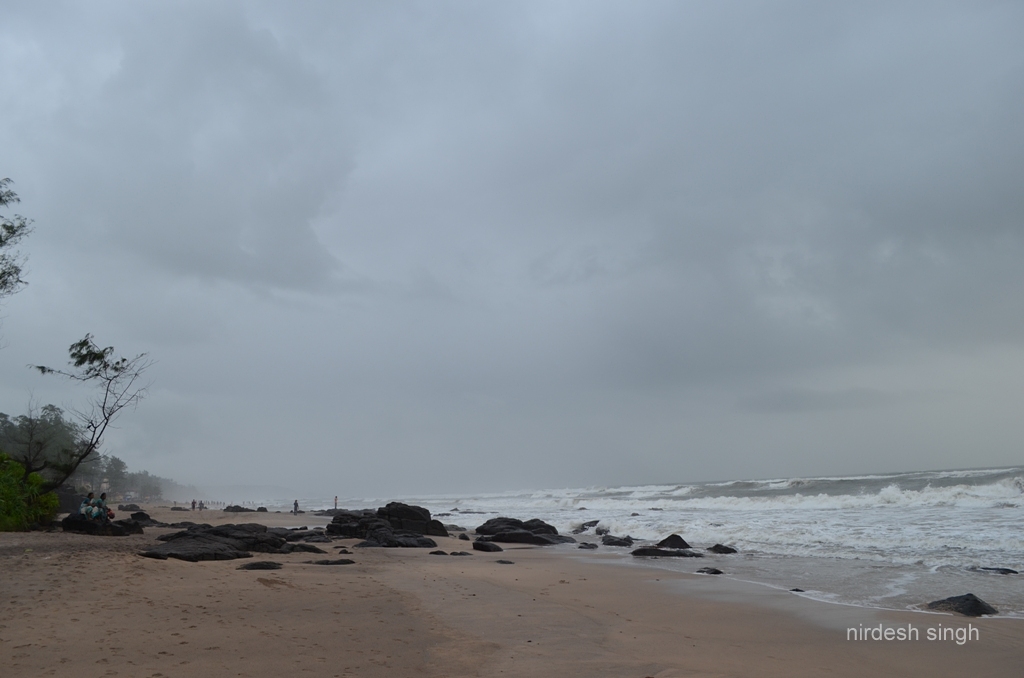
You feel the child-like excitement as you step on the soft sand with the waves coming in. Right now you cannot make out the horizon as clouds hang low on the waters. The beach on both sides is fringed with hills. Coconut palms, mangroves, cashew trees from the waters to the hills provide a green canopy. The hills above, the water beyond and the clean and golden beach all seem to be enveloped in this mist.


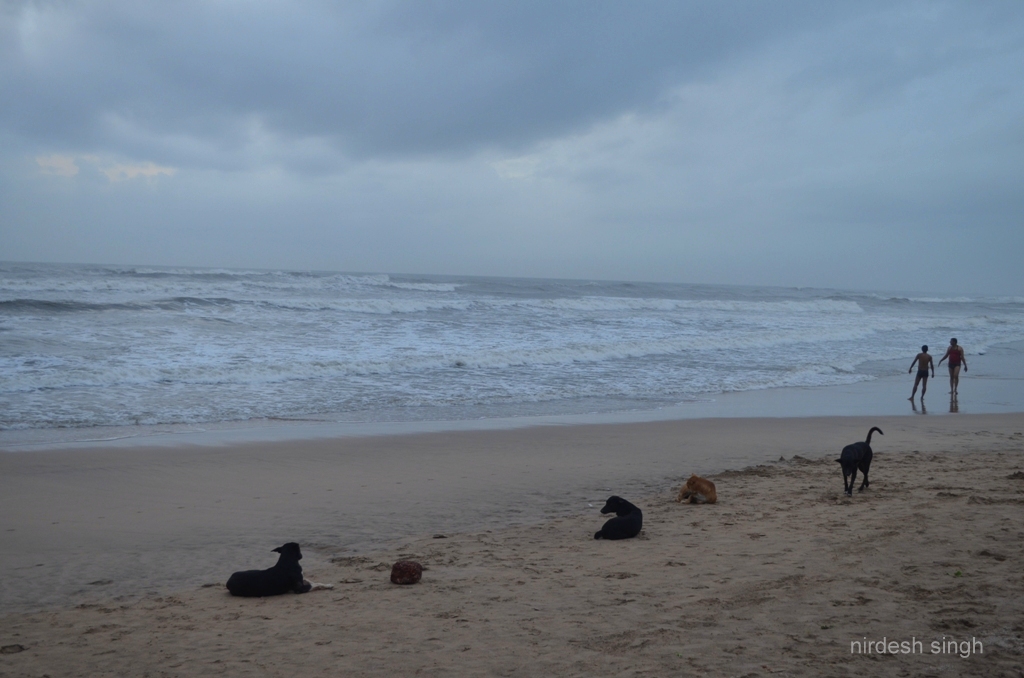
Dog Day Evening at Ganpatipule Beach Ratnagiri

In the rain, there are more dogs on the beach than tourists. Just as much dogs seem to love monuments, it seems they enjoy the beach even more. Shacks are boarded up; the MTDC resort on the hill looks vacant. You walk into the distance through the lapping waves. Some rocks still survive on the sands even after the lashing by the waves all these years. Sitting on the sand with your back against a rock will be your front row seat to the promised show in the sky.


Take your seats as the show is about to begin

And then things start to happen rapidly.


The Grand Celestial Show at Ganpatipule Beach

Notice the silver sliver of a horizon
It is sunset time. The rain stops all of a sudden, and the mist begins to lift over the hills. The seemingly stone like impenetrable grey skies break up to give shapes to the clouds that start to float revealing an opening. As if on cue, sun appears through this opening in the sky.
God has lifted the curtain off heavens especially for you. You have bought all the seats in the theater. For the next fifteen minutes, you are treated to a celestial spectacle as the sun and the clouds and the water come together to put up a soul-stirring performance ethereally choreographed just for you.


What you witness is truly indescribable. Spotlights dance over the waters. Light and shadows play on the water. The clouds, the streams of light and the rippling waves create 3D effects that no Transformers CGI computer can render. And you watch all this amazed and wide-eyed. Nature has her way to exhilarate and absolutely stun whoever cares to stop and listen and watch.


Curtains come down on the Celestial Spectacle - Ganpatipule Beach 

The clouds move back in. Now this particular cloud seems to hang over the waters. God has brought down the curtains after the spellbinding performance. You don’t remember ever seeing such a play of lights and shadows from a beach and you have seen plenty of sunsets on the sea. It is quite possible that together with the cliff hanging drive to the beach, this light-shadow play phenomenon is unique to Ganpatipule Beach.


One Last Look

Skies take colourful hues even as the curtains come down on another marvellous day in Konkan. It is time once again to walk reluctantly from another surprise here in Ratnagiri. Monsoons in Konkan provide myriad of colours and sights. Ratnagiri is just the beginning. The canvas that is coast of Karnataka beckons.

Getting There: Ganpatipule is 25 kms north of Ratnagiri in Maharashtra. For spectacular views of the sea and surf take the Aare Ware road which is different from the NH-17 Mumbai-Goa highway.

Ratnagiri lies on the south west coast of Maharashtra on the Mumbai-Goa highway and is well connected by trains from Mumbai. Ratnagiri is about about 350 kms from Mumbai and 300 kms from Pune. In Ratnagiri you can hire auto rickshaws to take you around the town and to the fort. The Jijamata Garden will offer you spectacular views of Arabian Sea and Bhatye Beach. Other attractions are the Ratnadurg with its Lighthouse and Thibaw Palace, now turned into a museum.

Travel Trip: On the way to Ganpatipule from Ratnagiri, if taking public transport, sit on the left of the bus to see the amazing views as you soar high above the cliffs with sea stretching into the horizon and waves crashing below your feet.

Reference: Outlook Traveller, July 2015 page 97

Related Posts on this Blog:

1. The Anguish of Thibaw Palace
2. Lokmanya Tilak Birthplace

A version of the story appears in Asian Age Mumbai edition on 11th July 2016